Calculator
Turn on JavaScript to use the calculator, or use the formulas below.
Cornerstones or long strips
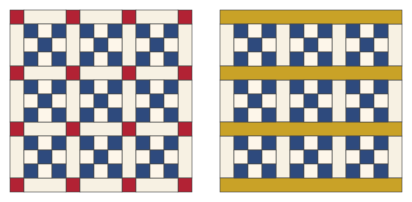
With cornerstones, every sashing strip is the same short piece, cut to the block’s unfinished size, and a small square sits at each crossing. Rows of blocks alternate with rows of strips and cornerstones, and every seam lines up with the one above it. That makes cornerstones the more forgiving choice: the matching points are built in, so blocks don’t drift out of line across the quilt.
Without cornerstones, short strips go between the blocks in each row, and one long strip runs the full width between rows. It looks calmer and has fewer seams, but the blocks in one row have to line up with the blocks in the next across a strip with no seams to match. Mark the long strip where each short strip should meet it before you pin.
How the numbers work
For a layout of A blocks across and D down, with blocks B inches finished and sashing s inches finished:
| Piece | Cut | Inside sashing only | With outer sashing |
|---|---|---|---|
| Sashing strips (cornerstone style) | s + ½ by B + ½ | D(A − 1) + A(D − 1) | D(A + 1) + A(D + 1) |
| Cornerstones | s + ½ square | (A − 1)(D − 1) | (A + 1)(D + 1) |
| Short strips (no cornerstones) | s + ½ by B + ½ | D(A − 1) | D(A + 1) |
| Long strips (no cornerstones) | s + ½ by the row width + ½ | D − 1 | D + 1 |
The finished top is A × B plus the sashing between blocks, (A − 1) × s, plus 2s more if the sashing also runs around the outside. The same goes for the length with D. The default example, twenty 12-inch blocks with 2-inch sashing and cornerstones all around, comes to 4 × 12 + 5 × 2 = 58 inches wide and 5 × 12 + 6 × 2 = 72 inches long.
Strips are cut across the fabric at 40 usable inches. Short pieces come from single strips, as many as fit; long strips longer than 40 inches are cut from strips joined end to end, with 2 inches spare per piece. Yardage is strips times strip width, plus 10%, rounded up to the next eighth of a yard. Cornerstones are usually a different fabric, so they get their own line.
Choosing a sashing width
A common starting point is a sashing about one quarter to one sixth of the block size: 2 to 3 inches for 12-inch blocks, 1½ inches for 6-inch blocks. Narrow sashing outlines the blocks; wide sashing turns them into separate islands, which suits a sampler or a signature quilt where each block should be read on its own. If the sashing width divides evenly into the block’s grid, say 1½ inches with a nine-patch made of 1½-inch squares, the seams line up visually across the quilt.
Sashing is also the easy way to stretch a set of blocks into a bigger quilt. Twenty 12-inch blocks set side by side make a 48 by 60 inch top; add 3-inch sashing with an outer frame and the same blocks make 63 by 78 inches.
Sewing sashing so the rows stay straight
- Trim every block to the same unfinished size first. Sashing shows any difference between blocks more than a plain setting does.
- Sew short strips between the blocks of each row (and at both ends, for outer sashing). Press toward the sashing.
- For cornerstones, sew the sashing rows: cornerstone, strip, cornerstone, strip, ending with a cornerstone if you have outer sashing. Press toward the strips, so the seams nest with the block rows.
- Join block rows and sashing rows, pinning at every seam. With long strips, mark the strip at each block edge first, using the measurements, not the row.
- Measure the top through the center before adding borders.
Related tools
Once the top is together, the quilt border calculator works out the borders from its measured size. To change a block’s size so the layout comes out right, use the block resizer. Simple blocks that look good sashed include the churn dash, the friendship star and the nine-patch; the T-shirt quilt pattern uses sashing to frame each shirt.
You might also like
 Quilt border calculatorStrip lengths and yardage for up to five borders, butted or mitered.
 Log cabin block calculatorEvery log length in sewing order and the yardage, for log cabin and courthouse steps.
 Panel quilt border calculatorBorder widths to take a fabric panel to a target size, strip lengths in sewing order, and border and binding yardage.
 Prairie points calculatorCut square size for any point height, how many points fill each edge, and the fabric to cut them from.