Calculator
Turn on JavaScript to use the calculator, or use the formulas below.
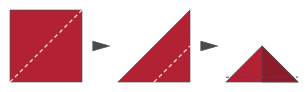
How the math works
A square of side S folded twice makes a triangle S wide at the base and S ÷ 2 tall. The base is the raw edge that goes into the seam, so a ¼-inch seam takes ¼ inch off the height.
| What | Formula | 2 in points |
|---|---|---|
| Cut square | 2 × (height + ¼) | 2 × 2¼ = 4½ in |
| Width of each point at the seam | the square's side | 4½ in |
| Spacing, touching | square side | 4½ in center to center |
| Spacing, nested | square side ÷ 2 | 2¼ in |
| Points on an edge | (edge − 2 × corner gap − square) ÷ spacing, rounded up, + 1 | 40 in edge, nested: (40 − ½ − 4½) ÷ 2¼ = 15.6 → 16 + 1 = 17 |
The count is rounded up so the points fill the whole edge, then the calculator spreads them evenly. On the 40-inch edge, 17 nested points come out every 23⁄16 inches (35 ÷ 16). The calculator rounds that to the nearest eighth and shows 2¼ inches, with an overlap of about 2⅜ inches, a little more than half. Lay them out, adjust by eye, and pin.
For a 40 × 45 lap quilt with nested 2-inch points, that's 17 points on each short side and 19 on each long side: 72 squares of 4½ inches. Eight fit across a 40-inch strip, so 9 strips, or 1¼ yards with 2 inches to straighten. Each fat quarter (17½ × 20½ usable) gives 12, so 6 fat quarters make a scrappy set.
Touching or nested?
Side by side, the points form a sawtooth with small valleys between them; it uses the fewest squares. Nested points slide the open side of one into the fold of the next, so they hold each other in line and look fuller. Nesting takes about twice as many squares. A custom overlap sits between the two.
For nesting, fold every point the same way so the open edge faces the same direction all along the quilt. A point folded with the opening on the wrong side won't take the next one.
Sewing them on
- Quilt the quilt, but stop the quilting about an inch from the edge. Trim the top and batting even, and fold the backing out of the way.
- Pin the points to the right side of the top, raw edges matching the raw edge of the quilt, points facing in toward the center.
- Sew them on with a ¼-inch seam through the top and batting only.
- Turn the points out so they face away from the quilt, and the seam allowance turns to the inside.
- Trim the backing, fold its edge under ¼ inch, and hand-stitch it over the seam on the back.
Or skip all that and add the points to a seam: between a border and the center, along a pillow's edge, or across a runner end before the binding.
Where not to use them
Prairie points stick out. That's the whole look, and it also makes them a poor choice on quilts that will be used hard by small children or in a care home. Our wheelchair lap quilt rules them out for exactly that reason: anything that can catch in a wheel or come loose doesn't belong on it. Check the program's rules before you add them to a donation quilt; the charity quilt size guide links each program's own page.
Common mistakes
- Cutting the square to the point height you want. The finished point is a little less than half the square.
- Running points into the corners, where they bunch up under the corner seams. Stop ¼ inch short, or leave a small gap and let the corner be plain.
- Quilting right to the edge first. You need room to fold the backing away.
- Pressing the folds with steam and stretching the bias edge. Press with a dry iron, set down and lifted.
Related pages
Prairie points look good on a table runner or a pillow cover, where the single-edge setting works. For a regular finish, see how to bind a quilt, and for points tucked into a border seam, how to add borders.
You might also like
 How many squares from a fat quarter? Fabric yield calculatorHow many pieces you can cut from a fat quarter, precut or yard, and how many to buy.
 T-shirt quilt calculatorThe layouts your shirts can fill, with the finished size and the fabric to buy.
 Rag quilt calculatorHow many squares and how much flannel a rag quilt takes at any size and seam allowance.
 Half-square triangle calculatorCut sizes for half-square triangles, hourglass units and flying geese, by method.