Calculator
Turn on JavaScript to use the calculator, or use the rule below.
The starting numbers are our log cabin quilt pattern: a 3-inch center, 1½-inch logs and three rounds for a 12-inch block, 30 blocks for a 60 × 72 inch throw. The log lengths and yardage match the pattern’s cutting table.
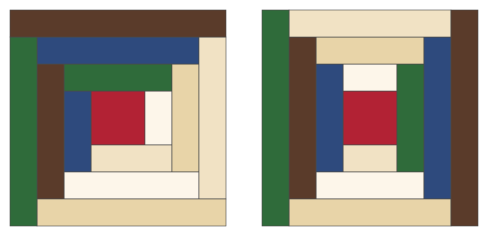
The one rule behind every log
Each log is exactly as long as the side of the unit it is sewn to. That’s all. Every log is cut the finished log width plus half an inch wide, and sewing it on adds one finished log width to the unit in that direction.
Take the pattern’s block. The center is cut 3½ inches. The first log goes on the right, so it is 3½ inches long, and the unit becomes 5 × 3½. The second log runs along the bottom, now 5 inches wide, so it is 5 inches. The third, on the left, runs the 5-inch height; the fourth, on top, runs the new 6½-inch width. Round 1 is done and the unit is 6½ inches square. Each round after that adds 3 inches (two log widths) and the same pattern repeats: the logs of a round are U, U + w, U + w and U + 2w, where U is the unit’s cut size at the start of the round and w the finished log width.
| Measurement | Formula | Pattern block |
|---|---|---|
| Log cut width | w + ½ | 2 in |
| Finished block | center + 2 × w × rounds | 3 + 2 × 1½ × 3 = 12 in |
| Logs per block | 4 × rounds | 12 |
| Longest log | unfinished block size | 12½ in |
Courthouse steps uses the same rule with a different order. Logs go on opposite sides in pairs: two of the same length on the top and bottom, then two longer ones on the left and right. Each round has two logs of length U and two of U + 2w. The light and dark fabrics fall on opposite sides instead of in an L, and the center stays in the middle of the block.
Strips and yardage
The calculator cuts each log length from its own 2-inch strips, as many pieces as fit in 40 usable inches, and adds 10% to the yardage for straightening. That matches the pattern, and it's the simplest way to work: one labeled stack of strips per length. Mixing several lengths on one strip saves a few strips, and the calculator says how many when it does, but you have to plan each strip.
The “sew and trim” method skips the cutting list: sew a long strip to the edge of the unit, trim it flush, and move on. It wastes a little fabric and is quicker for scrappy blocks, at the cost of the occasional crooked trim. The cut list is still worth having, to check each unit against the “unit after sewing” column.
Keeping blocks square
- Measure after every round. If a unit is an eighth too big, the next log is cut to the unit, not to the chart, or the error grows with every round.
- Press every seam away from the center, toward the newest log.
- Add logs in the same direction, clockwise or counterclockwise, on every block. Otherwise the light and dark halves switch sides.
- Narrow logs magnify seam errors: a 1-inch finished log with a sixteenth too much seam loses an eighth of an inch every round. Check your quarter-inch seam on scraps first.
Changing the look
Wider logs with fewer rounds make a bold, modern block; narrow logs and many rounds give the fine, striped look of antique quilts. Logs don’t all have to be one width: making the dark logs wider than the light ones curves the diagonal line between them. This calculator uses one width for all logs; for mixed widths, apply the same rule by hand, one log at a time. The red center is often said to stand for the hearth of the home, which makes the log cabin a natural choice for a memorial quilt or a housewarming gift.
Related tools and patterns
For the full quilt, with layout options and finishing, see the log cabin quilt pattern. Add borders with the quilt border calculator, or space the blocks with the sashing calculator. For a quick, related strip block, try the rail fence quilt.
You might also like
 Panel quilt border calculatorBorder widths to take a fabric panel to a target size, strip lengths in sewing order, and border and binding yardage.
 Quilt sashing calculatorEvery sashing strip and cornerstone to cut, with yardage for each.
 Courthouse steps quilt blockThe log cabin variation with logs sewn in opposite pairs, with cut lists for 6, 8 and 12 inch blocks.
 Quilt border calculatorStrip lengths and yardage for up to five borders, butted or mitered.