

The usual explanation for the name: the outer shape is the churn, and the center square is the dasher, the stick worked up and down to make butter. Block collections give it other names too, among them Monkey Wrench and Lincoln's Platform.
How the block is built
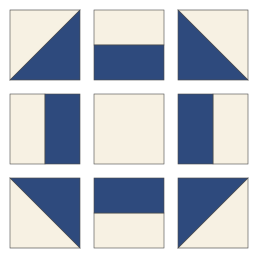
The block is a 3 × 3 grid. Each corner is a half-square triangle with background in the outer corner. Each side unit is two rectangles, background on the outside and print next to the center, sewn along their long edges into a square. The center is background.
Cutting chart (one block)
| Finished block | Unit | HST squares (2 background, 2 print) | Bars (4 background, 4 print) | Center (background) |
|---|---|---|---|---|
| 6 in | 2 in | 3 in | 1½ × 2½ in | 2½ in |
| 9 in | 3 in | 4 in | 2 × 3½ in | 3½ in |
| 12 in | 4 in | 5 in | 2½ × 4½ in | 4½ in |
The HST squares are cut 1 inch over the unit size so you can trim; the exact sizes are 2⅞, 3⅞ and 4⅞ inches. Each bar finishes half the unit wide and one unit long. The unfinished block is 6½, 9½ or 12½ inches. All sizes were checked by calculation.
Strip-piecing the bars is faster: for one block, cut one background strip and one print strip at the bar width (1½, 2 or 2½ inches) and at least 10, 14 or 18 inches long, sew them together along the long edge and cross-cut four segments at the unfinished unit size (2½, 3½ or 4½ inches). For several blocks in the same fabrics, use full width-of-fabric strips.
Choosing fabrics
The churn dash needs clear contrast between the print and the background, because the shape is drawn entirely by where they meet. Solids, tone-on-tones and small or medium prints all work. Very large prints lose their shape in 1-inch bars. Shirting fabrics (light backgrounds with small stripes or dots) are a traditional background and give a scrappy churn dash quilt an antique look.
If you want a third fabric, it fits in two places. Make the center square a contrasting print and it becomes the focus; make the bars a different print from the corners and the block looks layered. Changing only the center from block to block holds a scrappy quilt together.
Other sizes
The block works at any size divisible by 3, but the bars are half a unit wide, so sizes where the unit divides evenly in half are the easiest to cut. For a 15-inch block the unit is 5 inches: cut the center at 5½ inches, the HST squares at 6 inches, and the bars at 3 × 5½ inches. An 18-inch block (6-inch units) takes 6½-inch squares, 7-inch HST squares and 3½ × 6½-inch bars. Big churn dashes make a fast quilt: twenty 12-inch blocks, 4 across and 5 down, make a 48 × 60-inch top before sashing or borders.
Piecing steps
- HSTs: pair each background HST square with a print square, right sides together. Draw a diagonal on the background square, sew ¼ inch on both sides, cut on the line. Press toward the print. Trim the four HSTs to 2½, 3½ or 4½ inches.
- Bars: sew each background rectangle to a print rectangle along the long edge. Press toward the print. Each bar unit should measure the unfinished unit size square.
- Lay out the block. Turn each HST so the background triangle sits in the outer corner of the block. Turn each bar so its background strip is on the outer edge and its print strip touches the center square.
- Sew the three rows and press every seam toward the bars. In the outer rows that pushes the seams toward the middle of the block; in the middle row it pushes them outward, so the seams nest when you join the rows.
- Join the rows, nesting the seams. Press the long seams toward the middle row.
- Measure. A 9-inch block should be 9½ inches.
Common mistakes and fixes
| Problem | Cause | Fix |
|---|---|---|
| Corners point the wrong way | HST turned with the print in the outer corner | Background always goes to the block's outer corner |
| The "dash" looks broken | A bar turned with background next to the center | Print strips all touch the center square |
| Bar units not square | Strip widths cut or sewn inaccurately | Measure one strip set before cross-cutting; adjust the seam |
| Block a little small | Untrimmed HSTs sewn in at the exact size with a wide seam | Cut the larger HST squares and trim |
| Print shows through the cream | Seams pressed toward the background | Press toward the print |
Quilts made from churn dash blocks
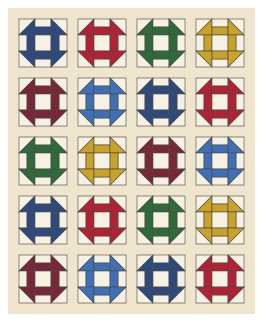
Churn dashes need some space around them. They're often set with sashing in the background fabric or a quiet tan, as above. Each block can be a different print, and one fat quarter of print makes several 9-inch blocks, so it's a good scrap quilt.
The block also works as a frame. Cut the center square from a shirt or a printed photo and the dash surrounds it. That's an easy start on a memory quilt from clothes. Set side by side with no sashing, the churn dashes touch at their corners and the background makes a secondary pattern of its own.
Related blocks with the same units: the shoofly uses the same corner HSTs with plain side squares, and the friendship star moves the HSTs to the sides. For a plain nine-patch quilt to start with, see the nine-patch throw.
You might also like
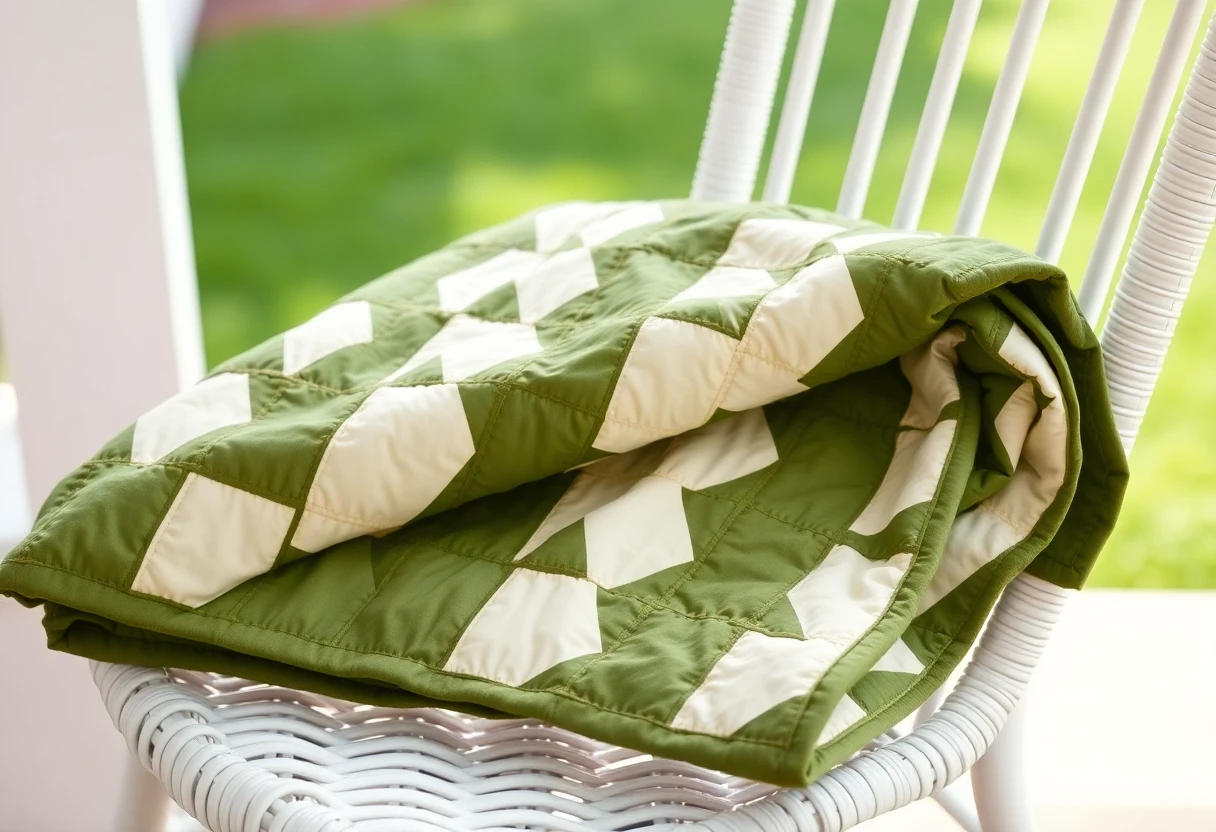 Shoofly quilt blockA nine-patch with half-square triangle corners, cut for 6, 9 and 12 inch blocks.
 Pinwheel quilt blockFour half-square triangles turned around the center, cut for 4, 6, 8, 10 and 12 inch blocks.
 Economy quilt block (square in a square)A center square framed by two rounds of triangles, with cut sizes for 4, 6, 8 and 12 inch blocks.
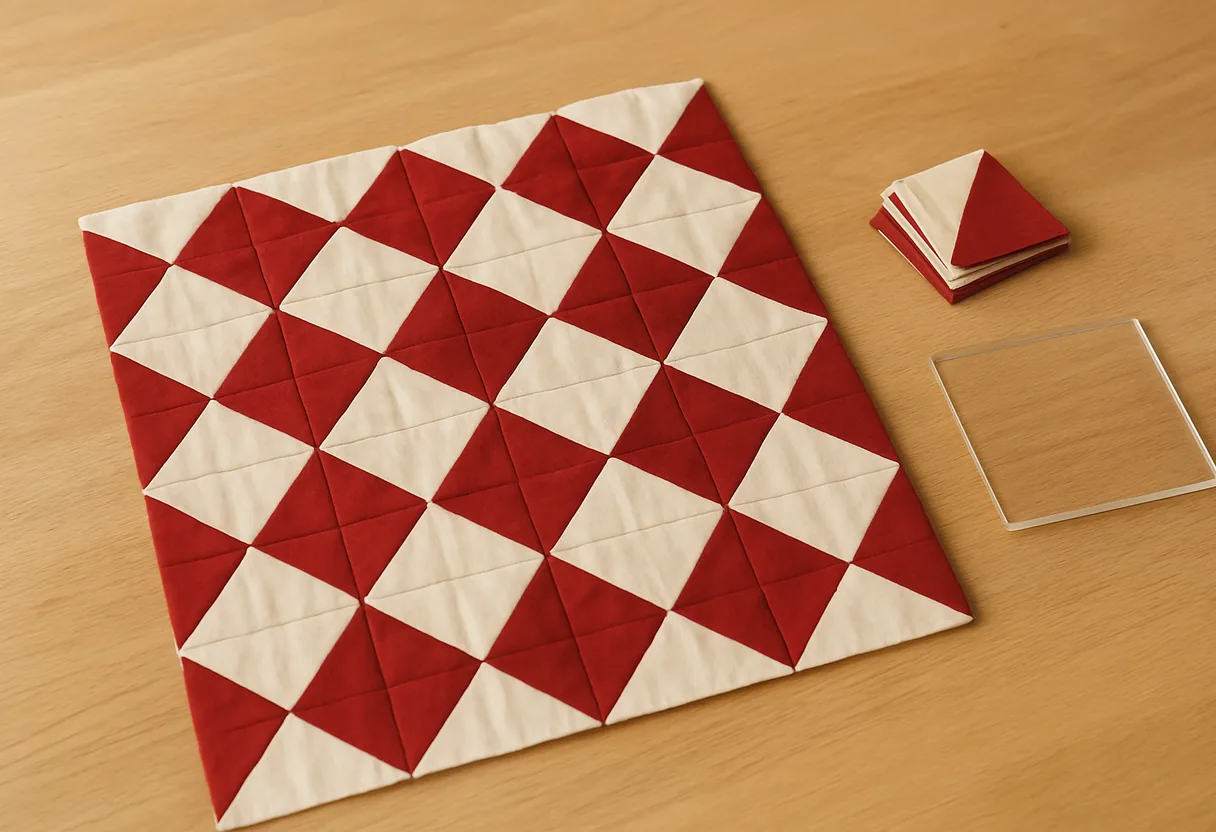 How to make half-square trianglesThe 2-, 4- and 8-at-a-time methods, a cut-size chart for each and how to trim.