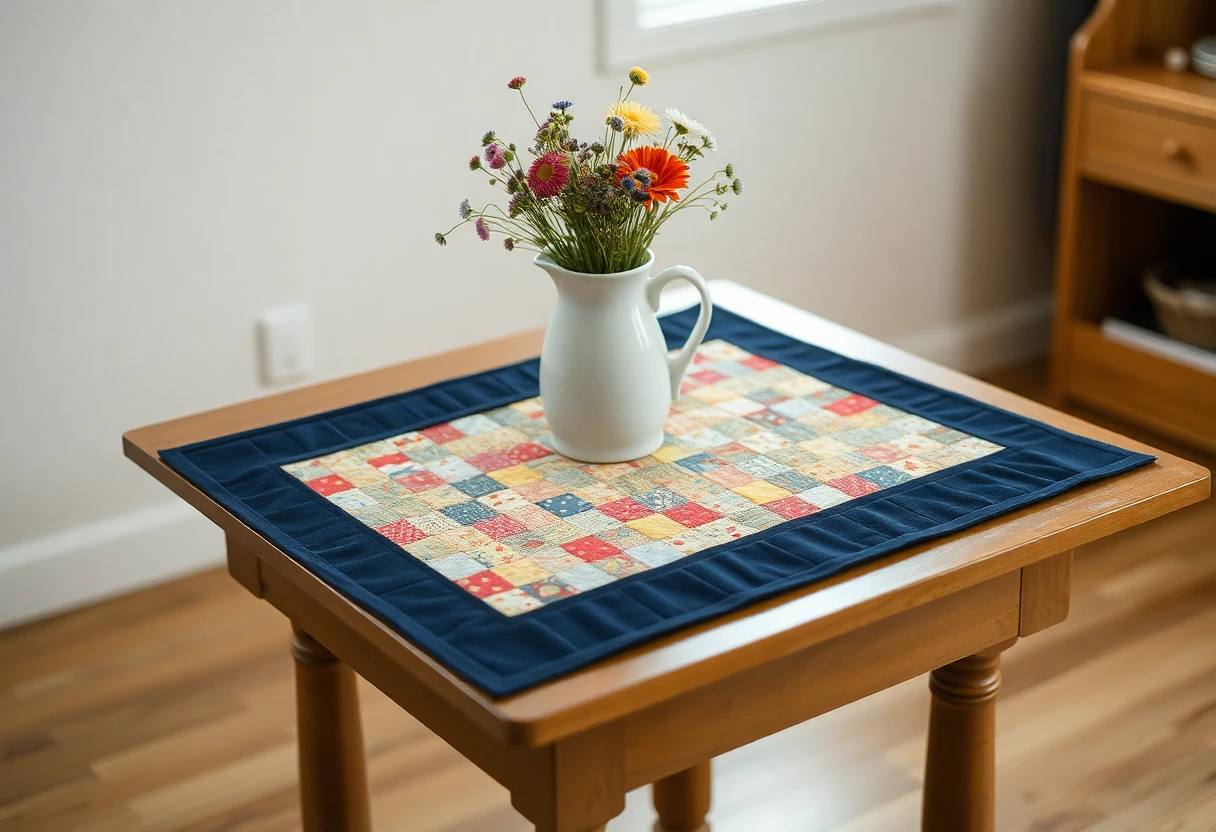
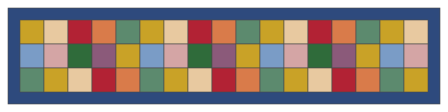
Pick your length first
Measure the table top end to end. A runner that hangs over the ends by about 6 inches on each side looks deliberate; one that stops about 6 inches short of each end leaves room for place settings at the head and foot. Either way, the runner length is 4 inches for every row of squares plus 4 inches for the borders.
| Runner | Drapes over a table of | Sits on a table of | Rows of 3 | Squares | Border strips | Binding strips | Backing |
|---|---|---|---|---|---|---|---|
| 16 × 36 in | – | 48 in | 8 | 24 | 3 | 3 | 24 × 44 in (1⅜ yd) |
| 16 × 48 in | – | 60 in | 11 | 33 | 4 | 4 | 24 × 56 in (1⅝ yd) |
| 16 × 60 in | 48 in | 72 in | 14 | 42 | 4 | 5 | 24 × 68 in (2 yd) |
| 16 × 72 in (this pattern) | 60 in | 84 in | 17 | 51 | 5 | 5 | 24 × 80 in (2⅜ yd) |
| 16 × 84 in | 72 in | 96 in | 20 | 60 | 5 | 6 | 24 × 92 in (2⅝ yd) |
| 16 × 96 in | 84 in | – | 23 | 69 | 6 | 7 | 24 × 104 in (3 yd) |
| 16 × 108 in | 96 in | – | 26 | 78 | 7 | 7 | 24 × 116 in (3⅜ yd) |
Border and binding strips are 2½ inches wide, cut across the width of the fabric. The backing yardage is for one piece cut along the length, so there's no seam. For a round or square table, a runner of 36 or 48 inches laid corner to corner often looks better than a long one.
Fabric for the 72-inch runner
| Fabric | Used for | Amount |
|---|---|---|
| Assorted prints | Fifty-one 4½-in squares | 4 fat quarters, or 1 yd of one print, or scraps |
| Navy (or any dark) | Border and binding | ¾ yd |
| Backing | One 24 × 80-in piece | 2⅜ yd |
| Batting | Middle layer | 24 × 80 in |
A fat quarter (about 18 × 21 inches) gives sixteen 4½-inch squares, so four of them give 64 and you can leave out the ones you like least. From yardage, each 4½-inch strip gives eight squares; seven strips cover 51.
For the other lengths: count one fat quarter per 16 squares, and figure the navy as the border strips plus the binding strips, each 2½ inches. For example, the 96-inch runner needs 6 + 7 = 13 strips, or 32½ inches of fabric: buy 1 yard.
Cutting
- Prints: fifty-one 4½-inch squares.
- Navy: ten 2½-inch strips across the width. Five are for the border and five for the binding.
- Backing: one piece 24 × 80 inches.
Cut the squares with a rotary cutter and ruler, not scissors. Stacking up to four layers of fabric and cutting them together is fine as long as the blade is sharp; a dull blade drags the bottom layer out of square. If you're new to the tools, quilting supplies for beginners covers what to buy.
Lay out and sew
- Lay all 51 squares out in three columns of 17, on the floor or a bed. Move squares around until no two of the same print touch. A photo on your phone shows clumps of one color better than standing over it.
- Sew the squares into 17 short rows of three. Chain-piece them: feed one pair after another through the machine without cutting the thread, then add the third square to each pair the same way.
- Press the seams in odd-numbered rows to the left and even-numbered rows to the right. The seams then lie in opposite directions when you join the rows, and the corners match.
- Join the rows in pairs, then pairs of pairs, then the groups. Short joins keep the long piece from twisting under the needle. The center measures 12½ × 68½ inches.
A consistent ¼-inch seam is the whole trick on this runner: if each seam is 1/32 inch too wide, the 16 seams along the length shorten it by a full inch. Our quarter-inch seam guide shows how to check yours with three scraps.
Add the border
- Join five navy strips end to end with straight seams and press the seams open.
- Measure the runner down the middle. Cut two border pieces that length (68½ inches if your seams were exact) and sew them to the long sides. Press toward the border.
- Measure across the middle, borders included (16½ inches), cut two pieces and sew them to the ends.
Quilt and bind
- Layer the backing right side down, then the batting, then the top right side up. Smooth each layer and baste with safety pins about every 4 inches. A runner is a good place to practice basting before a bed quilt.
- Quilt diagonal lines through the squares, corner to corner, in both directions to make a grid of Xs. The corners of the squares are your marking, so you don't need to draw anything. A walking foot keeps the layers from shifting.
- Trim the batting and backing even with the top, squaring the corners with a large ruler.
- Join the five binding strips with diagonal seams, fold in half lengthwise and bind. The runner needs 186 inches (the perimeter plus 10). See how to bind a quilt.
Make it seasonal
The same layout changes completely with the prints. Reds and greens make a Christmas runner in an evening (pair it with the Christmas quilt ideas for gifts). Oranges, golds and browns with a black border suit fall. For a striped look, sew 4½-inch strips together lengthwise and crosscut them into rows of three instead of cutting single squares; that's faster and gives a regular color repeat.
If you want something with a bit more piecing, try the stars and stripes runner or the Christmas star runner. Placemats to match: quilted placemats.
More free patterns: see them all. This pattern is free for personal and charity use; please don't sell the pattern itself.
You might also like
 Lap quilt for wheelchairs and nursing homesA plain, sturdy charity lap quilt of 5-inch squares, sized for a wheelchair (40 x 45 in) with 40 x 40 and 40 x 65 versions.
 Pumpkin patch Halloween wall hangingNine pieced pumpkins with black sashing and a purple border, 38 in square, with a table runner version.
 Fourth of July stars and stripes table runnerTwo navy friendship stars with nine red and white stripes between them, 16 x 46 in, an easy weekend runner.
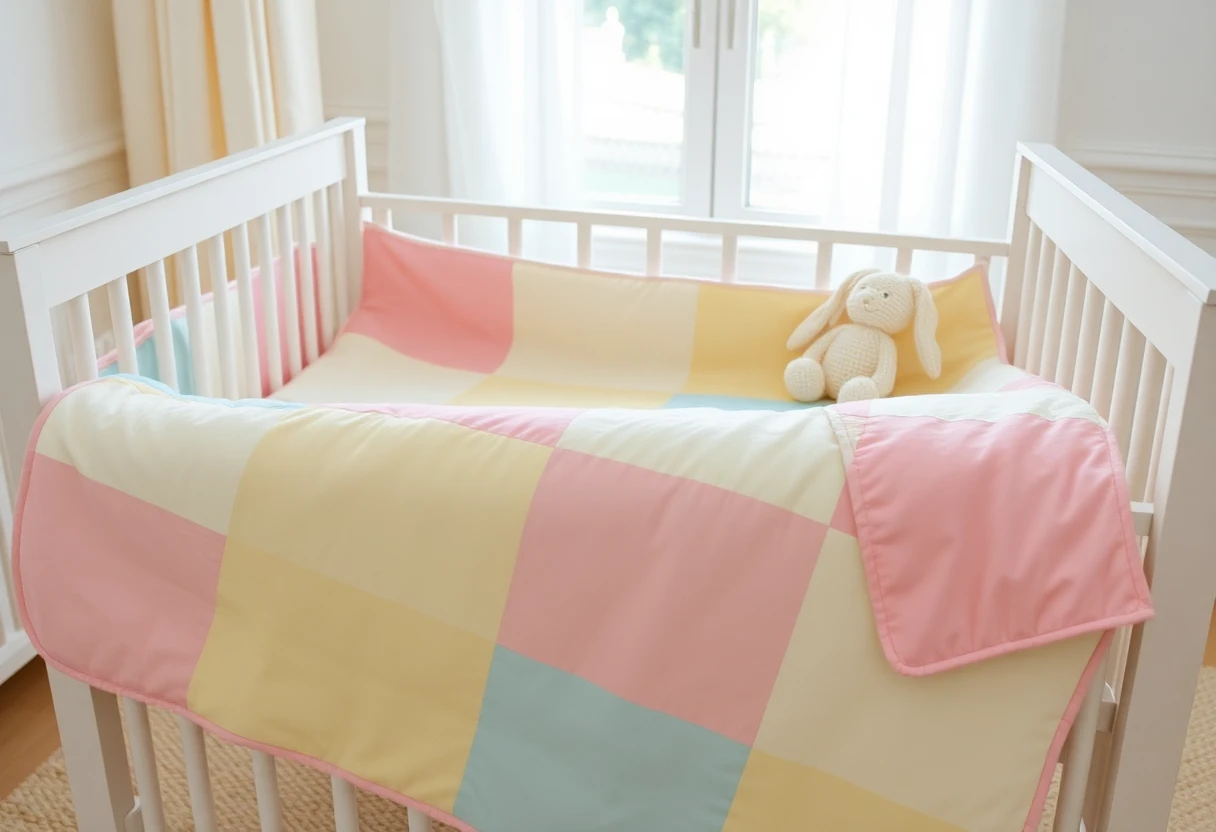 Easy baby quilt48 big squares from 8 fat quarters, 36 x 48 in, with crib, toddler and throw sizes.