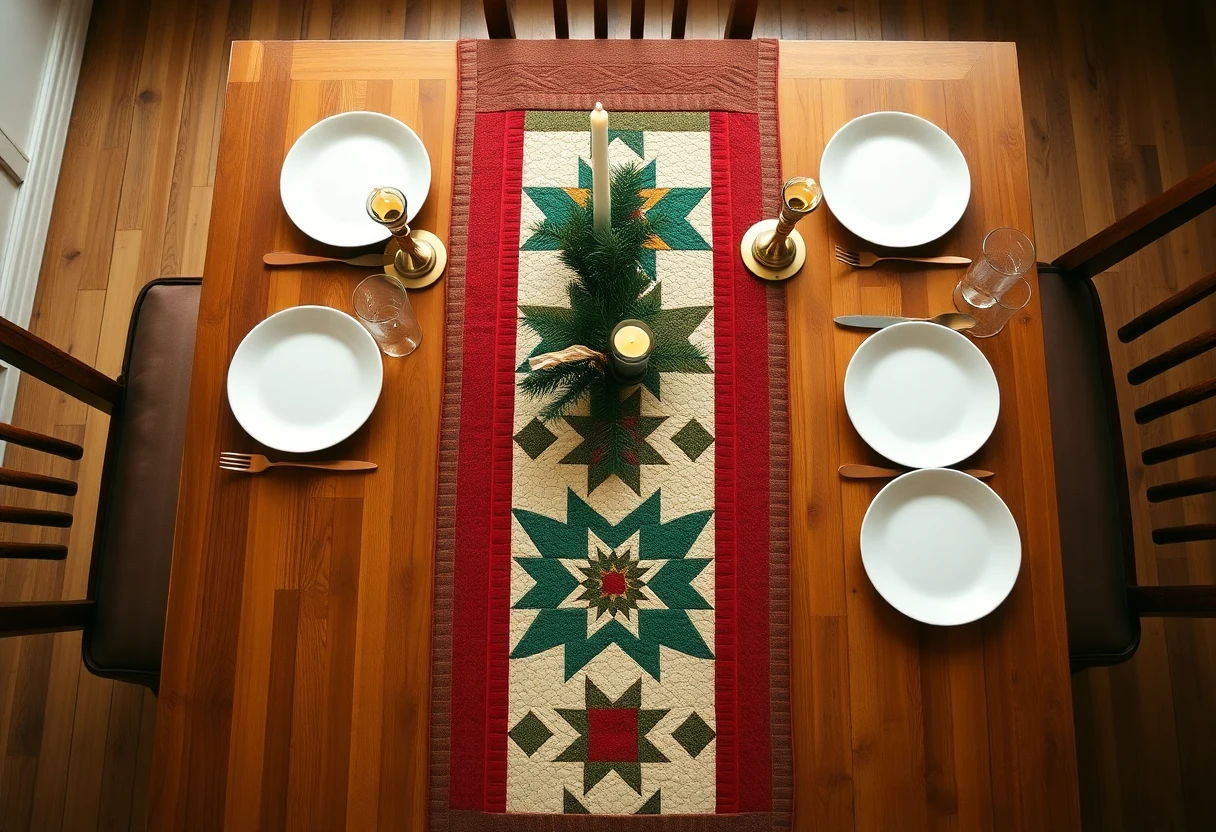

Fabric
| Fabric | Used for | Yardage |
|---|---|---|
| Green | Star points and two star centers | ½ yd |
| Gold | Middle star center | One 6½-in square (a scrap or fat quarter) |
| Cream | Background | ½ yd |
| Red | Border and binding | ⅝ yd |
| Backing | Back | 1⅜ yd |
| Batting | Middle layer | 24 × 48 in (crib size) |
Choosing the fabrics
The star is made of the green points and the cream geese between them, so the green has to be clearly darker than the cream from across a dining room. A mid green on a pale cream is safe. A dark pine on a gray-cream looks rich up close but goes muddy under candlelight; hold the two together under a lamp in the evening before you cut.
The center squares are the one place for a big Christmas print. They show at 6 inches, so a fussy-cut ornament, a poinsettia or a bit of plaid fits. The points want a small print or a tone-on-tone, because a busy print in a 3-inch triangle just looks like noise.
Gold metallic prints are popular for the middle center, and the metallic ink can smear or dull under a hot iron. Press that square from the back on a cotton setting without steam, or use a pressing cloth.
Red is the fabric most likely to bleed, and here it's sewn right next to cream on something that will be washed after the first gravy spill. Prewash the red, or at least wet a scrap and press it onto a white paper towel; if pink comes off, wash the whole piece before cutting. The first wash of the finished runner should go in cold water with a dye-catcher sheet.
Cutting
| Fabric | Cut |
|---|---|
| Green | Two 6½-in squares; twelve 3⅞-in squares (from two 3⅞-in strips) |
| Gold | One 6½-in square |
| Cream | Three 7¼-in squares (one 7¼-in strip); twelve 3½-in squares (two 3½-in strips) |
| Red | Three 2½-in strips for the border; four 2½-in strips for the binding |
The 7¼-inch and 3⅞-inch squares are exact sizes, so the geese come out at 3½ × 6½ inches only if your seam is a true ¼ inch. If you'd rather have room to trim, cut the cream squares 7½ inches and the green ones 4 inches, then trim each goose to 3½ × 6½. The same ½ yd of each fabric still covers it.
Make the stars
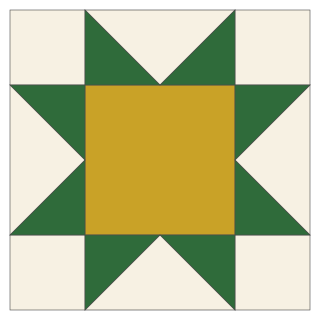
The blocks are the same sawtooth star used in our patriotic star quilt, and the sawtooth star block page has the step-by-step geese and the pressing order. For this runner:
- Make the flying geese four at a time: one 7¼-in cream square plus four 3⅞-in green squares gives four geese. Trim each to 3½ × 6½ in.
- Arrange each block in three rows: corner, goose, corner; goose, center, goose; corner, goose, corner. The cream triangles of the geese point at the center square.
- Sew the rows and join them. Each block should measure 12½ in square. Use the gold center for the middle block.
Finish the runner
- Sew the three blocks in a row. The runner center measures 36½ × 12½ in.
- Join the red border strips end to end. Cut two pieces 36½ in long and sew them to the long sides. Cut two pieces 16½ in long and sew them to the ends.
- Cut the backing to about 24 × 48 in. Layer it with the batting and the runner top, and baste.
- Quilt it. On something this small, straight lines ¼ inch outside each star with a walking foot look clean and take under an hour.
- Trim, then bind with the four red strips (see how to bind a quilt).
Keeping the star points where the stars meet the border
In a sawtooth star, each green point runs out to the edge of the block. On this runner that puts 16 point tips on the border seam (two per star on each long side, plus two at each end) and four more pairs where the stars meet each other, tip to tip, at the two block seams. A narrow red border makes any blunted tip easy to see.
When you join the stars, pin straight through the spot where the two tips meet. Sew the border with the runner on top, not the red strip, so all 16 tips stay in view as they pass under the needle.
If a block comes out at 12⅝ inches, don't trim it down. The points sit right on the edge, so trimming cuts them off. Ease the extra in with pins instead. A block that's ¼ inch or more off usually has one goose trimmed with its tip off-center, and remaking that goose is quicker than fighting it into the row.
Quilting ideas for this layout
Beyond the lines outside each star, stitching in the ditch around each center square makes the star sit forward. If you want more texture, fill the cream corners and geese with a small meander and leave the green points unquilted so they puff slightly. In the border, one line through the middle of the red is enough. Keep it fairly flat overall: a runner carries candlesticks and serving dishes, and heavy loft makes them rock.
A four-star runner for a longer table
Adding a fourth star makes a 16 × 52-inch runner. With an even number of stars there's no single middle block, so put gold centers in the two middle stars and green in the two ends.
| Fabric | Cut | Yardage |
|---|---|---|
| Green | Two 6½-in squares; sixteen 3⅞-in squares (two 3⅞-in strips) | ½ yd |
| Gold | Two 6½-in squares | A fat quarter |
| Cream | Four 7¼-in squares (one strip); sixteen 3½-in squares (two strips) | ½ yd |
| Red | Four 2½-in strips for the border; four 2½-in strips for the binding | ⅝ yd |
| Backing | One piece about 24 × 60 in | 1¾ yd |
| Batting | About 24 × 60 in | Crib size (45 × 60 in) is just long enough |
Checked by calculation: the center measures 48½ × 12½ inches. Cut the side borders 48½ inches and the end borders 16½ inches from the four joined strips. The four binding strips still go around: the runner's edge is 136 inches, and four strips give about 150 after joining.
Matching placemats
One star with a strip of cream on each side makes a 12 × 18-inch placemat. A dinner plate covers the middle of the star and leaves the points and corners showing around it. For a set of four:
| Fabric | Cut | Yardage |
|---|---|---|
| Green | Sixteen 3⅞-in squares (two strips) | ⅓ yd |
| Gold or green | Four 6½-in center squares (one strip) | ¼ yd |
| Cream | Four 7¼-in squares (one strip); sixteen 3½-in squares (two 3½-in strips); eight 3½ × 12½-in side strips (three more 3½-in strips, three per strip) | ¾ yd |
| Red | Eight 2½-in strips, two per mat, for binding | ⅝ yd |
| Backing | Four pieces about 16 × 22 in (two side by side across the width) | 1¼ yd |
| Batting | Four pieces about 16 × 22 in | One crib-size batt gives six |
Make four stars as above, sew a side strip to the left and right of each, and the top measures 18½ × 12½ inches. Making the runner and the mats from one red? Fifteen 2½-inch strips fit in 1⅛ yd. To skip binding four mats, our quilted placemats pattern uses a turn-and-topstitch finish; cut the backing and batting to 12½ × 18½ inches for that method and leave the red binding off the list.
Make it your own
Swap the green for a Christmas print and keep the cream plain so the star points still show. In red and navy, the same stars work for the Fourth of July, though our Fourth of July table runner was planned for that, with friendship stars and a stripe section.
More holiday projects: Christmas quilt ideas. Shopping for a quilter? StitchTested keeps a gift guide for sewers and quilters.
This pattern is free for personal and charity use; please don't sell the pattern itself.
You might also like
 Fourth of July stars and stripes table runnerTwo navy friendship stars with nine red and white stripes between them, 16 x 46 in, an easy weekend runner.
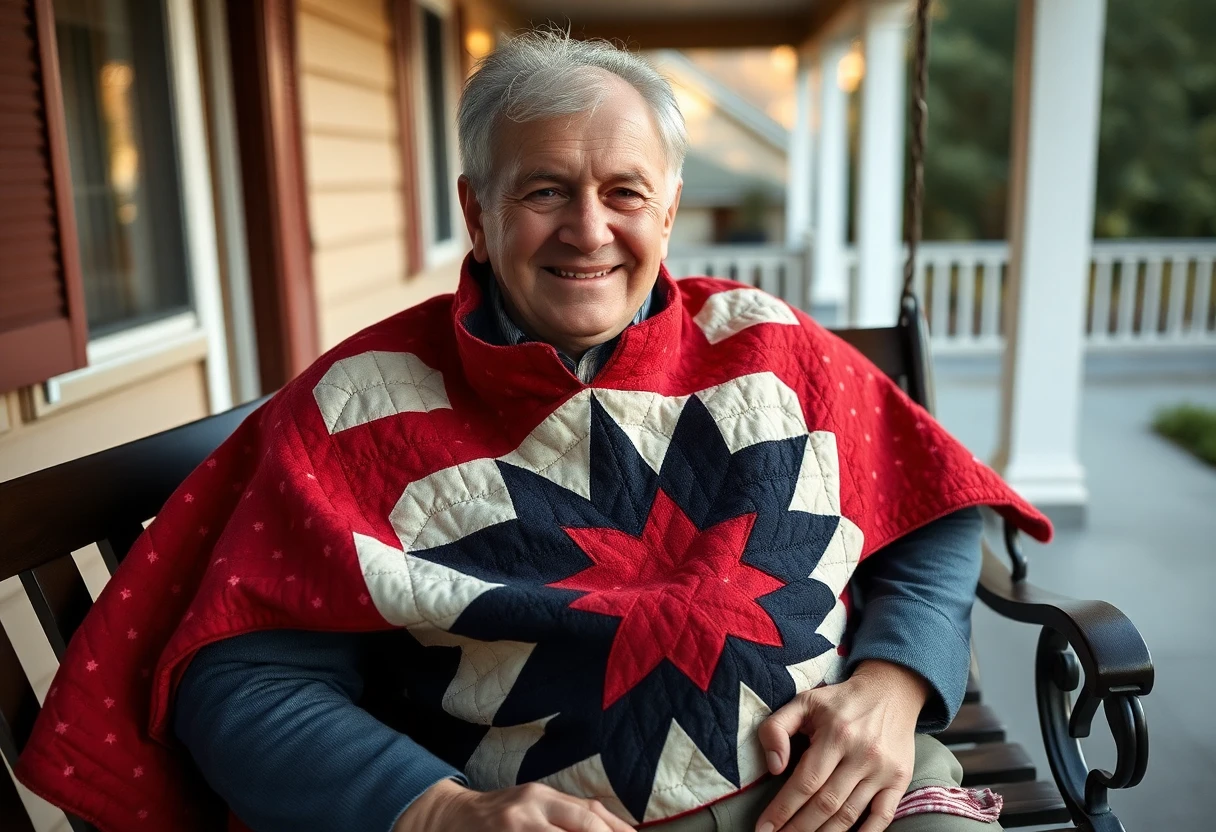 Patriotic star throw quilt20 red and navy sawtooth stars in a 58 x 70 in throw, sized to fit the Quilts of Valor range.
 Christmas quilt ideas, sorted by how much time you haveTwelve holiday projects, from one-evening gifts to a full Christmas throw.
 Quilted Christmas stockingA patchwork stocking with a lining, cuff and hanging loop, about 16 x 20 in, from a grid template.