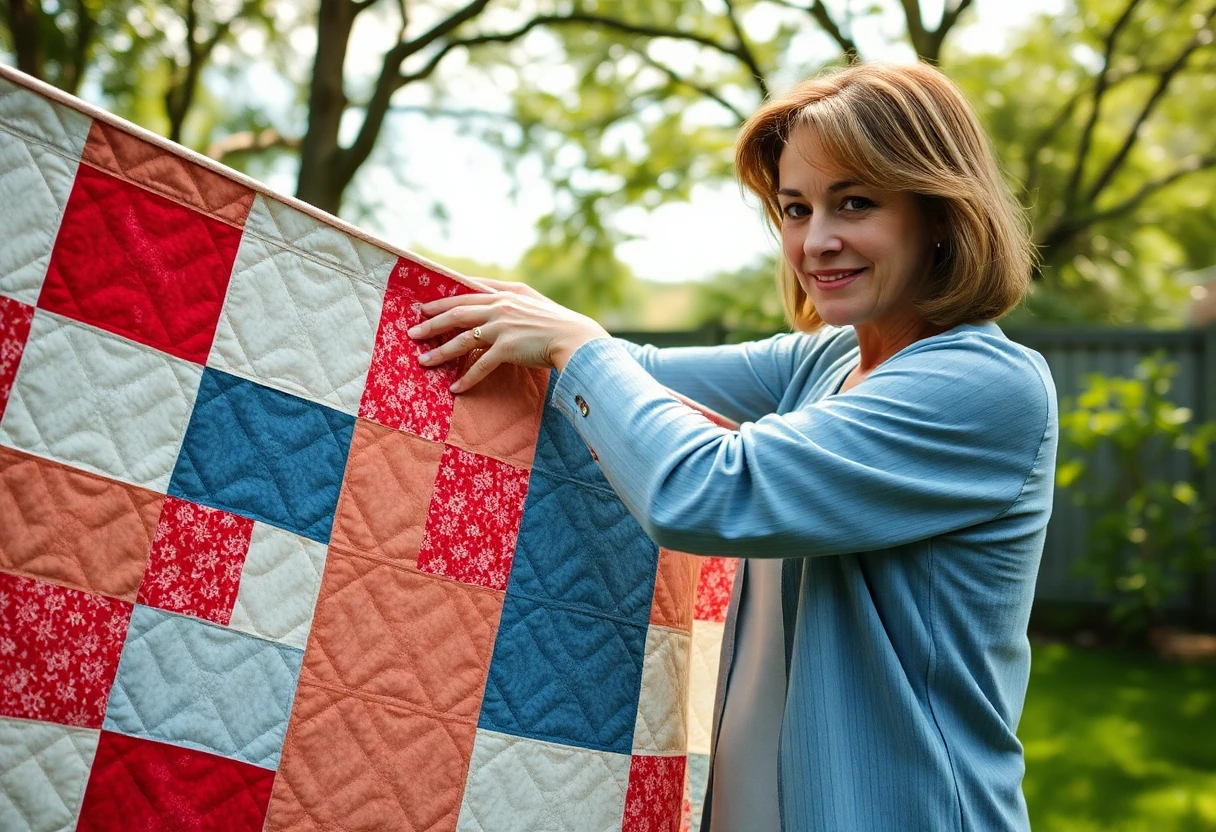
Washing a new quilt for the first time
The first wash is the risky one, because that's when loose dye from red, navy and other saturated fabrics comes out. It's also when cotton batting shrinks and the quilt gets its crinkle (see the batting guide for how much).
- Check that the binding is fully stitched down and no seams are open. A small gap grows in the washer.
- Use cold water and the gentle or delicate cycle. A front-loader or a top-loader without a center agitator is kinder to a big quilt.
- Use a small amount of a mild, unscented detergent. Skip fabric softener and bleach.
- Add color catchers. The Shout Color Catcher sheets lock up loose dye in the wash water, and Shout's directions say to use two sheets for large loads or loads with new, dark or non-colorfast items, which describes a new quilt. In a front-loader, Shout says to put the sheet in a mesh bag at the back of the drum.
- Look at the sheets afterward. If they're deeply colored, wash the quilt again with fresh sheets before using it, and don't let it sit wet.
Charity groups often ask for this exact routine. The Quilts of Valor Foundation asks that finished quilts be washed in cold water with a mild, unscented detergent and a color catcher (see our Quilts of Valor guide), and Quilts for Kids asks for a color catcher and no strong scents.
If a color runs
Don't put the quilt in the dryer. Heat can set the stain. Rewash it right away in cold water with new color catchers, and repeat while the sheets keep coming out colored. Leaving a damp, bled quilt in a heap is how a small pink haze turns into a big one.
Drying
A quilt full of water is heavy, and the weight pulls on seams. Lift it out of the washer in your arms rather than by one corner.
- Machine drying on low is fine for most cotton and poly quilts and gives the softest, crinkliest result. Pull it out while it's still slightly damp.
- Flat drying is gentler: lay the quilt on clean sheets or towels on a bed, a floor or a lawn, out of direct sun, and turn it once.
- A clothesline works for sturdy quilts if you spread the weight over two or three lines. Keep it in the shade; sunlight fades fabric.
- Wool batting needs care: Hobbs suggests a cool, gentle cycle with no heavy agitation for quilts with its wool batting, and laying them flat to dry.
How often to wash
As seldom as you can. A bed quilt that's used every day might go through the wash a few times a year; a wall quilt or a quilt folded on a chair, much less. Between washes, shake it out and air it in the shade. Spot-clean small marks with cold water and a drop of mild soap on a white cloth.
Old and antique quilts
Here the answer changes. The University of Nebraska–Lincoln's extension guide Care of Quilts: Cleaning, written by textile specialists Shirley Niemeyer and Patricia Crews, says that experts disagree about cleaning methods and that it's usually best to leave an old quilt as it is. It says very old, fragile or valuable quilts should go to a professional textile conservator rather than be cleaned at home, and that valuable quilts should never be machine washed, even on the delicate cycle.
Before doing anything, check that the fabric is sound and the colors won't bleed, then weigh the risk against what the quilt is worth to you, in money or in family history. A quilt from a grandparent can be irreplaceable even when its market value is small.
Vacuuming: the gentlest cleaning
The Nebraska guide describes a vacuuming method that suits many old quilts. Lay the quilt flat, cover a section with a piece of fiberglass or nylon window screen (about 2 by 3 feet), and vacuum through the screen on low suction, holding the nozzle about ½ to 1 inch above the surface. Move the screen and repeat across both sides. This lifts surface dust without pulling at weak threads.
If a sturdy old quilt must be wet cleaned
The same guide gives a careful method for quilts that are sturdy and colorfast. In brief:
- Test every fabric and thread: put a few drops of water on a hidden spot and blot with a white blotter. If any color shows, don't wet clean the quilt.
- Use a bathtub, with a screen under the quilt to carry its weight. Room temperature water, no warmer than 90 to 100°F, and soft or distilled water if you can.
- Use about 1 tablespoon of mild liquid hand-dishwashing detergent per 4 gallons of water (not laundry detergent) and let it soak at least 30 minutes. Don't scrub, squeeze or wring.
- Rinse five to seven times, at least 15 minutes each, until the water is free of soap.
- Lift it out on the screen, press out water with towels, and dry it flat on towels over a plastic sheet, out of the sun. A fan 3 to 4 feet away helps. No dryer.
Read the full guide before you try this. With the soak and all those rinses it takes a couple of hours, and a wet quilt can tear under its own weight.
Storing quilts
The companion guide, Care of Quilts: Storage and Display, covers storage. Its main points:
- Store quilts flat and unfolded if you can. If you must fold, fold as few times as possible, pad the folds with crumpled acid-free tissue, and refold along different lines now and then so creases don't become permanent breaks.
- Or roll the quilt loosely on a tube at least 4 inches in diameter and longer than the quilt is wide, padded with batting and covered in acid-free tissue or washed muslin. Never roll a folded quilt.
- Keep quilts off bare wood, including cedar chests, and out of ordinary cardboard and paper. Line shelves and boxes with acid-free tissue or washed, unbleached cotton muslin.
- Don't store quilts in plastic bags. Skip attics, basements, kitchens and unheated rooms, where temperature and humidity swing. Pick somewhere dark.
- Don't stack heavy things on top; it creases the quilt and crushes the batting.

Common mistakes
| Mistake | What happens | Do this instead |
|---|---|---|
| Hot water on a new quilt | Reds bleed; cotton batting shrinks more | Cold water and color catchers |
| Drying a quilt that bled | Heat sets the stain | Rewash in cold with new sheets first |
| Washing an heirloom on the delicate cycle | Weak fabric splits, old dyes run | Vacuum through a screen, or ask a conservator |
| Storing in a plastic tub or bag for years | Trapped moisture, permanent fold lines | Acid-free tissue, cotton muslin, refold now and then |
A clear label with care instructions helps whoever inherits the quilt; see how to label a quilt. For hanging and displaying a quilt, see how to hang a quilt.
Products on this page
Photos and prices come from Amazon and can change.
 Shout Color Catcher dye-trapping sheets, 24 countCheck price on Amazon
You might also like
 Free-motion quilting for beginnersMachine setup, practice sandwiches and three first motifs, including the meander or stipple.
 English paper piecingWrap fabric around paper shapes, baste with thread or glue, then stitch the edges together by hand.
 How to baste a quiltBuilding the quilt sandwich and holding it together with pins, spray or thread, with sizes and spacing.
 How to hang a quiltA 4-inch hanging sleeve with exact cuts, rods and slats, big and memorial quilts, and how to keep a hung quilt safe.