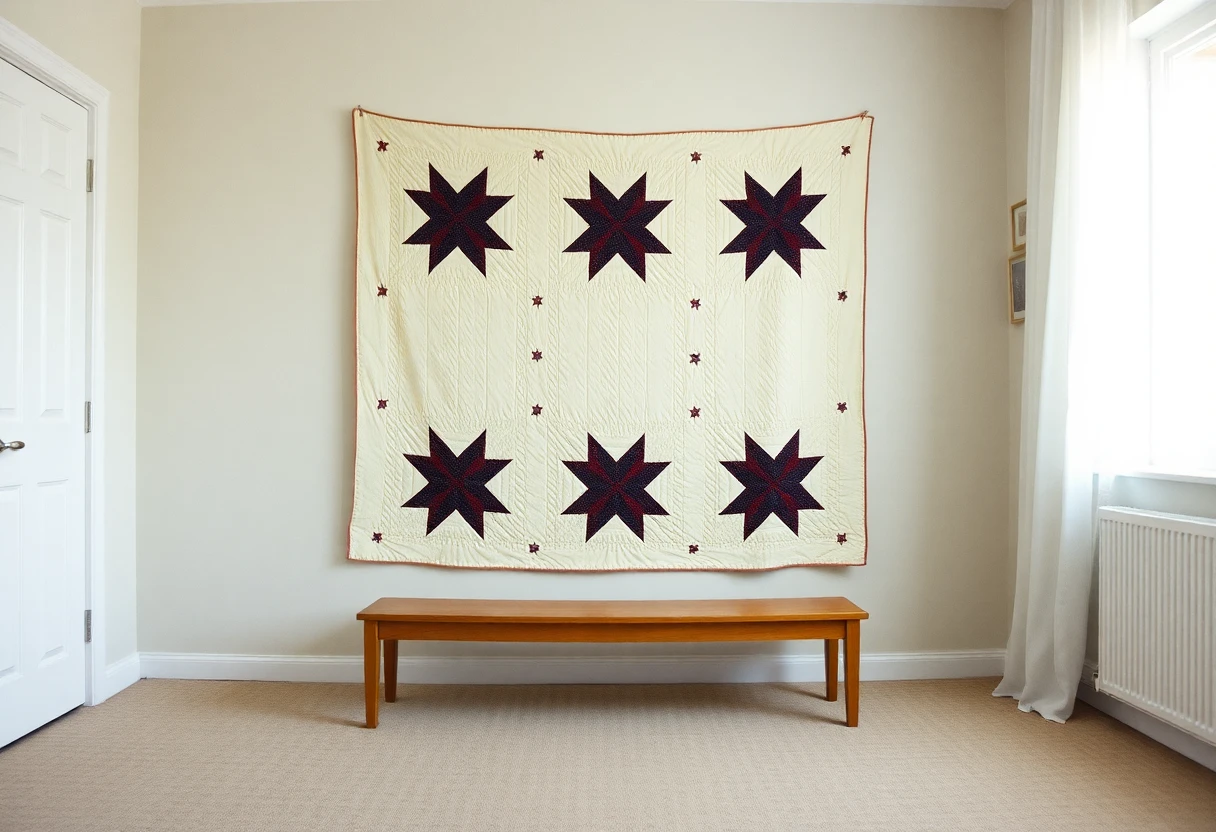
Why not just use nails or clips?
The University of Nebraska–Lincoln's extension guide Care of Quilts: Storage and Display says never to hang a quilt with nails, staples, tacks or pins. They put severe stress on small spots and break threads, and metal can leave rust marks. The guide says the weight should be spread evenly across the full width, and a sleeve does that.
The sleeve: measurements
The American Quilter's Society publishes sleeve instructions for quilts entered in its shows: cut the sleeve 8½ inches wide by the exact width of the quilt. Folded in half and seamed at ¼ inch, an 8½-inch strip makes a tube 4 inches deep, wide enough for a curtain rod or a 1 × 2 or 1 × 3 slat to slide through. The 2026 AQS contest rules require a sleeve on every entry except miniatures.
For hanging at home, make the sleeve a little shorter than the quilt so the ends of the rod are exposed for the hardware. The table works that way: the strip is cut 1 inch shorter than the quilt is wide, and the hems at each end take off another inch.
| Quilt width | Cut sleeve strip | Finished sleeve | Rod or slat length |
|---|---|---|---|
| 36 in | 8½ × 35 in | 4 × 34 in | 35 in |
| 48 in | 8½ × 47 in | 4 × 46 in | 47 in |
| 60 in | 8½ × 59 in | 4 × 58 in | 59 in |
| 72 in | 8½ × 71 in | 4 × 70 in | 71 in |
| 91 in | 8½ × 90 in (or two pieces, see below) | 4 × 89 in | 90 in |
The rod is 1 inch shorter than the quilt, so it hides behind it, and ½ inch longer than the sleeve at each end, which leaves room for a screw eye or a bracket. If a show asks for the AQS size, cut the strip the full width of the quilt instead.
A strip longer than your fabric is wide can be pieced. Join two pieces with a ¼-inch seam and press it open. Use a plain, sturdy cotton; muslin or leftover backing fabric is ideal. If the sleeve will stay on for years, the Nebraska guide suggests a double layer of fabric so the rod never rubs against the quilt itself, which the tube already gives you.
Making and attaching the sleeve
- Cut the strip 8½ inches wide by the length from the table.
- Hem both short ends: fold under ¼ inch, fold again, and stitch. (AQS uses a scant ¼-inch seam here.)
- Fold the strip in half lengthwise, right sides together, sew the long raw edges with a ¼-inch seam, and turn it right side out. You now have a 4-inch tube.
- Press the tube flat with the seam running down the middle of one side. That side goes against the quilt.
- Center the sleeve across the back of the quilt, with its top edge ½ to ¾ inch below the top of the quilt, so it won't peek over when the quilt hangs. If the binding is already on, tuck the sleeve's top edge just under the binding's stitching line.
- Hand stitch the top edge to the backing and batting with a blind stitch, catching only the back layer of the sleeve. Don't let stitches go through to the front of the quilt.
- Before sewing the bottom edge, push it up about ½ inch so the outer layer of the tube has some slack. Pin and blind stitch the bottom edge of the back layer.

That slack in step 7 matters more than it looks. Without it, the round rod fills the flat tube and a bulge shows along the top of the quilt from the front. The AQS instructions build in the same give by stitching along pressed fold lines so the outer layer cups out.
For sturdy quilts the Nebraska guide recommends large stitches, ¼ inch or longer, which hold well and are easy to snip out later without harming the quilt.
Rods, slats and hardware
- A wooden slat (a 1 × 2 or 1 × 3 board, or lath) is the simplest. Sand it, then seal it with paint or polyurethane and let it cure, or wrap it in muslin, so raw wood doesn't touch the fabric. Put a screw eye in each end and hang the eyes on small nails or screws in the wall.
- A curtain rod with brackets works for a quilt you change often. Pick a rod that doesn't sag across the width.
- Commercial quilt hangers clamp the top edge between two bars. They're fine for small, sturdy pieces but put more pressure on one line than a sleeve does.
- For a small wall hanging under about 24 inches wide, two fabric triangles sewn into the top corners of the back (before binding) hold a thin dowel or slat with no sleeve.
Check that the rod is level before you step back. A slat that's an inch low on one side makes the whole quilt look crooked.
Big and memorial quilts
A heavy or very wide quilt needs more support than one long rod. Make two sleeves, each a little under half the width, and leave a 2-inch gap in the middle for a center bracket. The rod then rests on three points instead of sagging.
The five quilts of the 9-11 Memorial Quilt Project show the scale involved: the World Trade Center and Pentagon quilt tops each measured about 91 × 160 inches (see how the quilts were built). For a quilt that size, a sturdy slat or rod, a split sleeve, and two people to lift it are the minimum. If it's going to a museum or public building, ask what hanging system they use before you sew the sleeve.
A few more points for memorial and keepsake quilts:
- Hang it on an inside wall, away from heating vents, fireplaces and direct sunlight. The Nebraska guide also says to avoid rooms that are lit most of the time.
- Rest it. The same guide says to take a quilt down at least every six months, and suggests putting sleeves on two quilts so one can rest while the other hangs.
- Keep the label on the back, where it can be read when the quilt comes down. If it doesn't have one yet, see how to label a quilt.
- For a single memorial block or a cross-stitched square (like those in how to cross-stitch a memorial square), a shadow box frame keeps the fabric away from the glass.
- If you're organizing a group memorial quilt, plan the sleeve when you plan the size; see how to make a memorial quilt.
Common problems
| Problem | Cause | Fix |
|---|---|---|
| A ridge shows along the top | No slack in the sleeve's outer layer | Restitch the bottom edge with ½ inch of ease |
| The sleeve shows above the quilt | Sleeve sewn too close to the top edge | Move it to ½ to ¾ inch below the edge |
| Quilt sags in the middle | Rod too thin for the width | Use a stiffer slat or a split sleeve with a center bracket |
| Edges curl or wave | The quilt isn't square, or the quilting is uneven | Block it, or add a second slat in a bottom sleeve for weight. See how to square up a quilt |
| Fading on one side | Window light | Move it, and rotate quilts on display |
Washing before display? See how to wash a quilt.
You might also like
 How to sew an accurate quarter-inch seamThe scant quarter inch, a three-strip test that tells you if your seam is right, and how to press it.
 Quilt as you go: joining quilted blocks with stripsQuilting each block on its own, then joining them with narrow front and back strips, with exact cut sizes.
 How to square up a quiltTrimming blocks to exact size, squaring the quilted quilt before binding, and fixing wavy borders.
 How to wash a quiltThe first wash, color catchers, drying, what to do with an old or antique quilt, and safe storage.