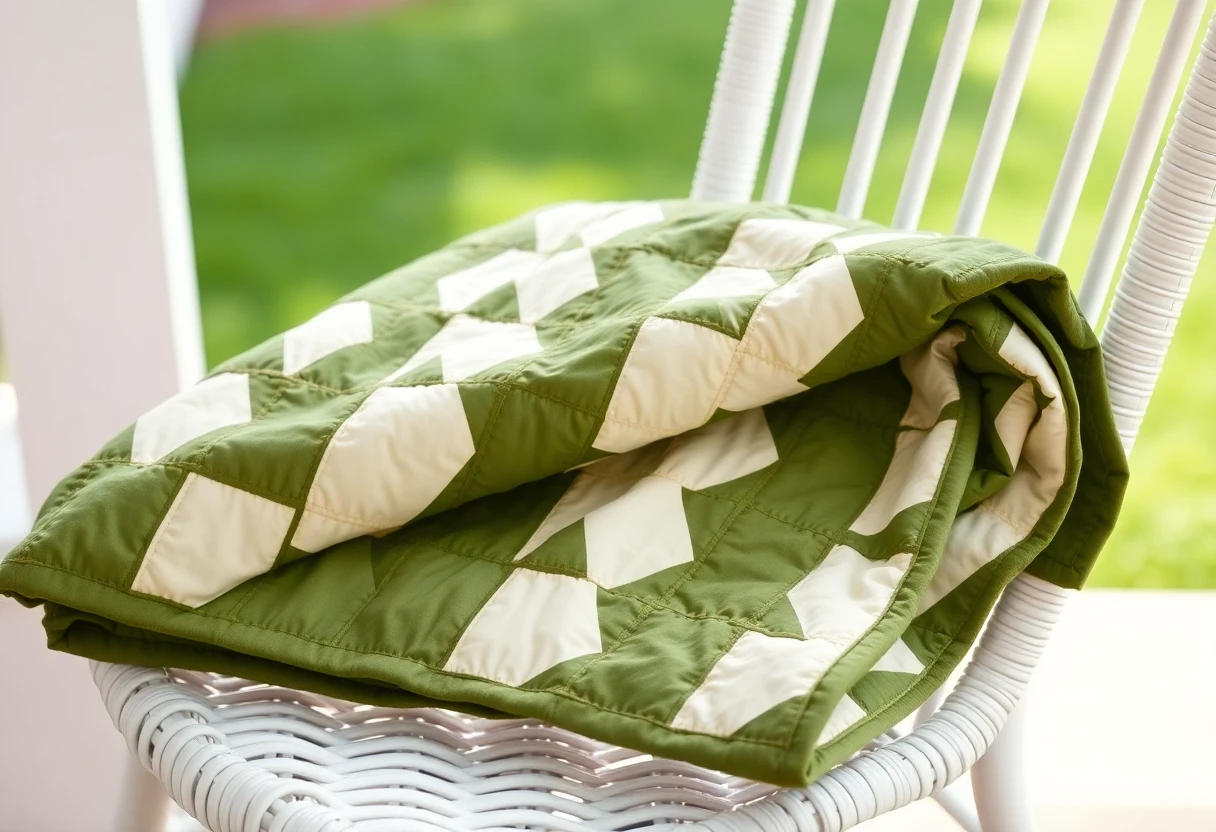

Nobody knows for certain where the name comes from. Fons & Porter's Quilting Daily calls the origin speculative and mentions a plant once said to drive off flies, and notes that "Hole in the Barn Door" was another name for the block popular with farmers in the mid- to late 1800s. You'll find it spelled shoofly and shoo fly; they're the same block.
How the block is built

A 3 × 3 grid. In each corner HST, the print triangle sits in the block's outer corner and the background half faces the center. With the print center, the print forms an X across the block. Turn the HSTs the other way, print toward the center, and you get a different look: a ring of print with background corners. Both are correct blocks; just keep all four corners the same in any one block.
Cutting chart (one block)
| Finished block | Unit | HST squares (2 background, 2 print) | Background side squares | Print center |
|---|---|---|---|---|
| 6 in | 2 in | 3 in | 4 squares 2½ in | 1 square 2½ in |
| 9 in | 3 in | 4 in | 4 squares 3½ in | 1 square 3½ in |
| 12 in | 4 in | 5 in | 4 squares 4½ in | 1 square 4½ in |
The HST squares include extra for trimming; cut them at 2⅞, 3⅞ or 4⅞ inches if you prefer not to trim. Unfinished block: 6½, 9½ or 12½ inches. Checked by calculation.
A charm square (5 inches) is big enough for the HST squares and center of a 12-inch block; that's a quick way to make a scrappy set from one charm pack and a background fabric.
Choosing fabrics
The shoofly depends on contrast between the print and the background more than on the prints themselves. Lay the two fabrics side by side and take a black-and-white photo with your phone: if they turn into the same gray, the X will disappear. A medium or dark print on a light background is the safe choice. Busy, large-scale prints get chopped up in 3-inch units, so save those for the plain alternate blocks, where the whole print shows.
Two colors are traditional, but the block takes a third easily: make the center square a different fabric from the corners, and the X turns into four corner triangles around a contrasting middle. In red and blue on cream it becomes a patriotic block for a Fourth of July table runner or a lap quilt for a veteran.
Other sizes
Any finished size divisible by 3 works. Divide the block by 3 to get the unit, then cut the side squares and center at the unit plus ½ inch and the HST squares at the unit plus 1 inch (or plus ⅞ inch for exact). A 15-inch block, for example, has 5-inch units: 5½-inch squares and 6-inch HST squares. For a 10-inch block the unit is 3⅓ inches, which no ruler marks cleanly, so pick a size divisible by 3 instead.
Piecing steps
- Pair each background HST square with a print square, right sides together. Draw a diagonal on the wrong side of the background square.
- Sew ¼ inch from the line on both sides. Cut on the line.
- Press toward the print. Trim the four HSTs to 2½, 3½ or 4½ inches with the seam running exactly corner to corner.
- Lay out the block. Top row: HST, background square, HST. Middle row: background, print center, background. Bottom row: HST, background, HST. Turn each HST so its print triangle is in the outer corner of the block.
- Sew the top and bottom rows and press toward the HSTs. Sew the middle row and press toward the center square. The seams nest when you join the rows.
- Join the rows. Press the two long seams toward the middle row, or open.
- Measure: the block should be ½ inch larger than its finished size.
Making a dozen or more? Cut from strips: a 4-inch strip across the width of the fabric gives ten 4-inch HST squares, and a 3½-inch strip gives eleven 3½-inch squares (counting on 40 usable inches). Chain-piece all the HST pairs at once, then all the rows, and keep each block's units in a stack so the prints stay together.
Common mistakes and fixes
| Problem | Cause | Fix |
|---|---|---|
| One corner looks different | An HST turned with print toward the center | Check all four corners before joining rows |
| Corner point cut off at the block edge | HST seam off the corner after trimming | Trim with the 45-degree line on the seam |
| Seams won't nest | Rows pressed the same direction | Outer rows toward the HSTs, middle row toward the center |
| Block too small | Seam allowance wider than ¼ inch | Test your seam; see how to sew a quarter-inch seam |
Quilts made from shoofly blocks
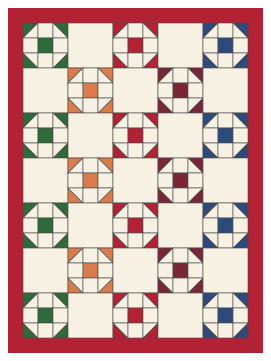
Alternating shooflies with plain squares spaces the blocks out and halves the piecing. The plain squares are where the quilting shows, so put a simple feather in them, or stitch a name and date into one. Use a different print in each shoofly, as in the diagram, and you have a scrap quilt held together by a calm cream background.
Set side by side without plain blocks, the outer triangles of neighboring blocks meet and form larger print squares on point where four corners come together, a secondary pattern that's easy to miss until the blocks are sewn. For a quilt in this size range with a full cutting chart, our nine-patch throw uses the same alternating layout with plain nine-patches, and you can swap in shooflies of the same 9-inch size.
Related blocks: the churn dash uses the same corners with two-strip bars on the sides, and the friendship star moves the triangles to the side positions.
You might also like
 Churn dash quilt blockHalf-square triangle corners and two-strip bars, cut for 6, 9 and 12 inch blocks.
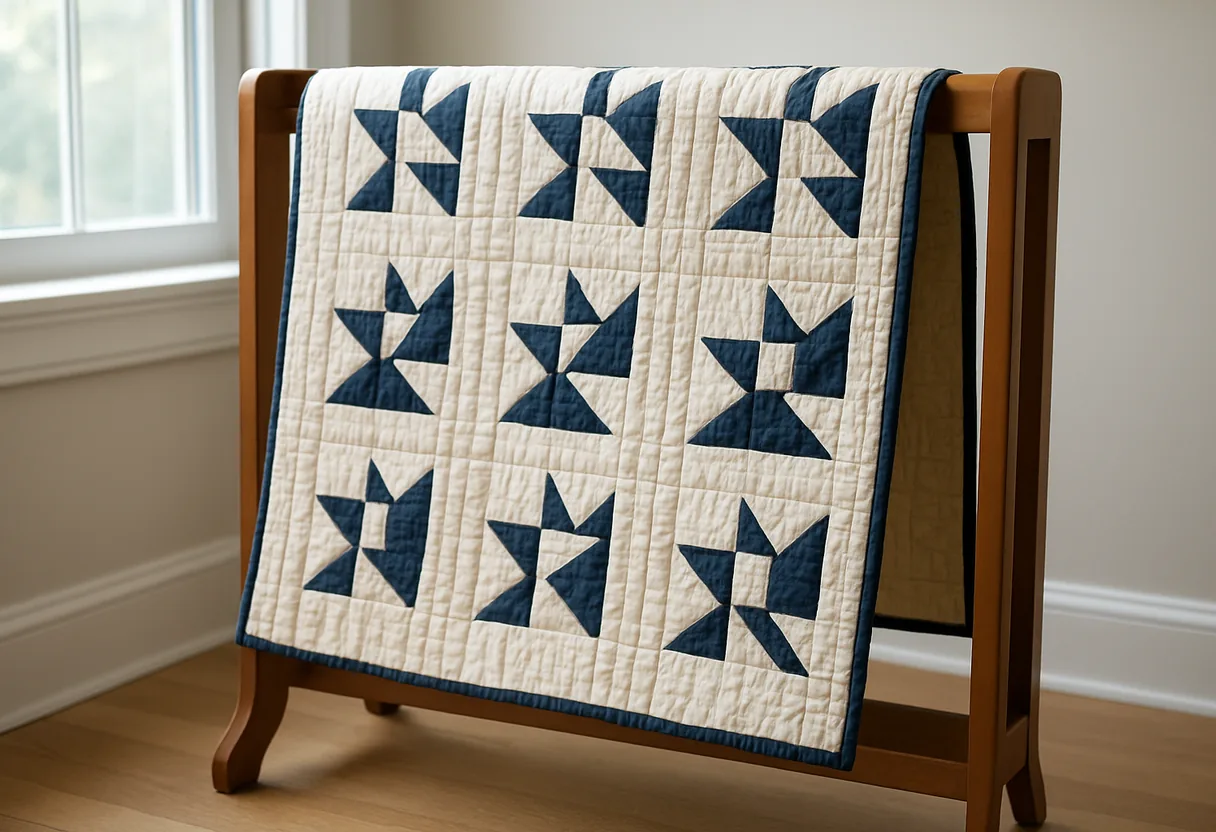 Friendship star quilt blockA nine-patch star of four half-square triangles, with a plain center for signatures.
 Pinwheel quilt blockFour half-square triangles turned around the center, cut for 4, 6, 8, 10 and 12 inch blocks.
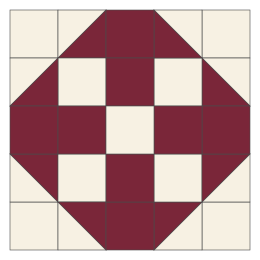 Sister's choice quilt blockA five-patch with a nine-patch center and eight triangle points, cut for four sizes.