Hexagon template generator
Turn on JavaScript to draw the template. The measurements are in the table further down this page.
Print at 100% (in the print dialog this is often called “actual size”; turn off “fit to page”). Then measure the square in the top corner with a ruler. If it isn't exactly 1 inch, the printer scaled the page and every hexagon is off by the same amount. The Download SVG link saves the same sheet as a file that a cutting machine program can open at its real size.
Side length or across the flats?
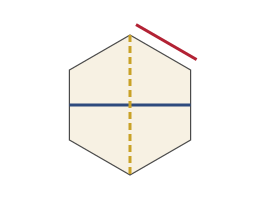
Paper piecing papers and acrylic templates are almost always named by the length of one side, so a “1-inch hexagon” has 1-inch sides and is about 1¾ inches across. Some patterns, and most machine-piecing rulers, give the distance across the flats instead, because that is the width of the strip you cut. If a pattern says only “2-inch hexagons”, check which it means before printing 200 papers: a 2-inch side and a 2-inch width differ by more than an inch.
The three measurements are tied together:
| You know | Side length | Across the flats | Across the points |
|---|---|---|---|
| Side s | s | s × 1.732 | 2s |
| Flats w | w ÷ 1.732 | w | w × 1.155 |
| Points p | p ÷ 2 | p × 0.866 | p |
The 1.732 is the square root of 3, which comes from the hexagon being six equilateral triangles meeting in the middle. A seam allowance a moves every edge out by a, so the cutting hexagon is 2a wider across the flats, and its side grows by a × 1.155.
Common sizes
| Side | Across the flats | Across the points | Fabric piece with ⅜ in allowance | Pieces per 40-in strip |
|---|---|---|---|---|
| ½ in | 0.87 in | 1 in | 1⅝ × 1⅞ in | 24 |
| ¾ in | 1.30 in | 1½ in | 2⅛ × 2⅜ in | 18 |
| 1 in | 1.73 in | 2 in | 2½ × 2⅞ in | 16 |
| 1¼ in | 2.17 in | 2½ in | 3 × 3⅜ in | 13 |
| 1½ in | 2.60 in | 3 in | 3⅜ × 3⅞ in | 11 |
| 2 in | 3.46 in | 4 in | 4¼ × 4⅞ in | 9 |
Fabric pieces are rectangles rounded up to the next ⅛ inch, cut from strips as tall as the longer number, using 40 usable inches of width. You can trim the corners off each rectangle before basting, or leave them; they fold to the back with the rest of the allowance.
For a first English paper piecing project, 1-inch sides are easy to hold and fold. Half-inch hexagons look lovely and take four times as many pieces to cover the same area: a 60 × 72-inch quilt needs about 1,739 one-inch hexagons, or about 6,790 half-inch ones.
English paper piecing calculator
Turn on JavaScript to use the calculator, or use the rules below.
How the counts work
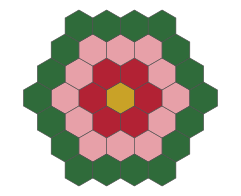
Each ring around a center hexagon holds 6 more hexagons than the one inside it: 6, then 12, then 18. A flower with k rings has 1 + 3k(k + 1) hexagons, which is 7 for one ring and 19 for two. In a grandmother's flower garden the flowers are separated by a path one hexagon wide, and neighboring flowers share the path between them, so the calculator lays the flowers out in columns and counts each path hexagon once. Inside a big quilt that works out to about 5 path hexagons per one-ring flower and 8 per two-ring flower; the edges add more.
For a plain area, the hexagons sit in rows 1½ side lengths apart, with every other row shifted half a hexagon. The count includes the half hexagons that stick out at the edges, because you need a whole paper for each of them before you trim the edge straight.
Fabric is counted from strips as tall as one fabric piece, across 40 usable inches of width, and rounded up to the next ⅛ yard. If each ring is a different fabric, as in the classic flower, each line of the table is its own fabric.
Tips for the papers
- Print papers on card stock or heavy printer paper. Plain copy paper works too, but it softens after a few uses; papers can be reused several times if they come out clean.
- Cut on the inside edge of the printed line. A thick line on every side adds up across a row of 20 hexagons.
- Stack two or three sheets and cut them together with sharp paper scissors, or use a rotary cutter you keep for paper, never the one you use on fabric.
- Punch a small hole in the middle of each paper. It makes them easier to pop out with a pin or a chopstick when the time comes.
Common mistakes
Printing at the wrong scale is the big one. “Fit to page” shrinks the sheet a few percent, which is enough that your hexagons won't match purchased papers or a friend's. Always measure the 1-inch square.
Mixing measuring systems is the second: buying 1-inch papers and printing a 1-inch-across-the-flats template to go with them. Pick side length or across the flats and stick to it for the whole project.
The third is cutting fabric with a skimpy allowance. With ¼ inch the fabric barely reaches around a small paper and frays at the corners; ⅜ inch is easier for hand work. Machine piecing hexagons is different: there the ¼-inch template is the right one.
For the hand method itself, read the English paper piecing guide. Hexagons are only one shape; the curved and 60-degree template generator prints diamonds, triangles, tumbling blocks and clamshells the same way, and the Dresden plate generator makes another classic hand-pieced block. A flower garden quilt still needs the usual finishing: see basting, hand quilting and binding.
You might also like
 Dresden plate template generatorPrintable blade and center circle templates for any blade count and plate size, with fabric and a preview.
 Quilt label makerType the details, pick a style (simple, star border, memorial, Quilt of Valor, signature) and print at true size on fabric sheets or paper for tracing.
 Curved and 60-degree template generatorTrue-size templates for drunkard's path, orange peel, clamshell, apple core, triangles, diamonds and tumbling blocks.
 Template resize calculatorThe printer percentage to enlarge or reduce a template or paper piecing pattern, plus a printable table.