Template generator
Turn on JavaScript to draw the template. The formulas are in the table below.
Print at 100% (“actual size”, not “fit to page”) and measure the 1-inch square. The dashed line is the cutting line and the solid line the sewing line. Small ticks across the curves mark their centers, for matching when you pin. A shape too big for a Letter page gets a warning and a Download SVG file at full size instead; the same file opens in cutting machine software.
What the size means for each shape
| Shape | Finished size f is | How the shape is drawn |
|---|---|---|
| Drunkard's path | one side of the finished square unit | a quarter circle of radius ½f, ⅝f or ¾f in one corner; the L piece is the rest of the square |
| Orange peel | one side of the finished background block | two arcs of radius f, each centered on a corner of the block; the petal is f × 1.414 long and 0.586f wide |
| Clamshell | the finished width (it's as tall as it is wide) | a half circle of radius ½f on top; the bottom curves are the tops of the two shells in the row below |
| Apple core | the distance between corners | four arcs of radius ⅝f; the sides bulge out by ¼f and the top and bottom curve in by ¼f, so the waist is ½f |
| Equilateral triangle | the side length | height f × 0.866 |
| 60-degree diamond, tumbling blocks | the side length | angles of 60 and 120 degrees; the distance between parallel sides is f × 0.866 |
How the seam allowance is added
Each edge is moved out by the seam allowance a, measured square to the edge. For straight edges that's simple. For a curve, the cutting line is a curve with the same center and a radius a larger where the shape bulges out, or a smaller where it curves in. That is why a drunkard's path quarter circle with a 2½-inch finished radius is cut with a 2¾-inch radius, and its L piece with a 2¼-inch radius: the two cutting lines are ½ inch apart, and once both are sewn with ¼ inch, the finished curves match exactly.
| Shape | Cutting rule with seam allowance a | With a = ¼ in |
|---|---|---|
| Drunkard's path quarter circle | radius r + a | r + ¼ in |
| Drunkard's path L piece | square f + 2a, curve radius r − a | f + ½ in, r − ¼ in |
| Equilateral triangle | strip height = f × 0.866 + 3a | finished height + ¾ in |
| 60-degree diamond | strip width = f × 0.866 + 2a | finished width + ½ in |
The triangle gets 3a rather than 2a because the point of a 60-degree angle sits twice as far from the sewing line as a flat edge does. The pointed seam allowances on triangles and diamonds are long. Trim the tips blunt, square to the point and just outside the sewing line, and the pieces line up much more easily.
Notes on each shape
Drunkard's path
Two pieces make one square unit, and one unit turned four ways makes dozens of layouts. Pin at the center ticks first, then the ends, and sew with the L piece on top. The drunkard's path block guide has the sewing method and eight layouts. A medium curve is the easiest to sew; small curves are tighter and large curves leave a thin L piece.
Orange peel
The petal is usually appliquéd across the diagonal of a background square, tip to tip from corner to corner. Turn every other block a quarter turn and the petals of four blocks meet around each corner, so the curves read as overlapping circles. With fusible web, print with no seam allowance and trace onto the paper side; for needle-turn, use ⅜ inch.
Clamshell
Clamshells are often made by turning the top curve under over a template, or English paper piecing them, and appliquéing each row over the stems of the row below. Each row adds half a shell of height, and each row shifts sideways by half a shell. Printing with no seam allowance and filling the page gives the shells nested as they'll sit in the quilt.
Apple core
Every apple core has two edges that bulge and two that curve in, so it's one shape that does the job of both drunkard's path pieces. Turn every other piece a quarter turn and the bulges nest into the curves. Pin often, starting at the center ticks, and sew slowly. Apple cores make a good scrap quilt, since every piece can be a different fabric.
Triangles, diamonds and tumbling blocks
All three cut from straight strips with the 60-degree line on a ruler. Equilateral triangles alternate point up and point down along a strip and make rows with no seams to match except the points. Six diamonds make a six-pointed star. Three diamonds in a light, medium and dark fabric make a tumbling block that reads as a cube; the blocks then join like hexagons, which makes them a natural project for English paper piecing.
Common mistakes
- Printing at the wrong scale. Measure the 1-inch square every time; a sheet printed at 97% makes curves that don't meet.
- Cutting the convex and concave pieces with the same allowance rule. They differ: one gets bigger, the other smaller.
- Stretching bias edges. Curves are partly on the bias. Starch the fabric before cutting and handle the pieces as little as you can.
- Sewing curves fast. Stop every inch or so with the needle down and realign the edges.
For hexagons in any size, use the hexagon template generator; for wedges and plates, the Dresden plate template generator. The half-square triangle calculator covers the straight-seam units.
You might also like
 Hexagon template generatorTrue-size hexagon sheets for paper piecing, with a count and fabric calculator for rosettes and whole quilts.
 Dresden plate template generatorPrintable blade and center circle templates for any blade count and plate size, with fabric and a preview.
 Quilt graph paper generatorTrue-scale square, on-point, hexagon and 60-degree triangle grids for sketching quilts, with heavier lines and an SVG download.
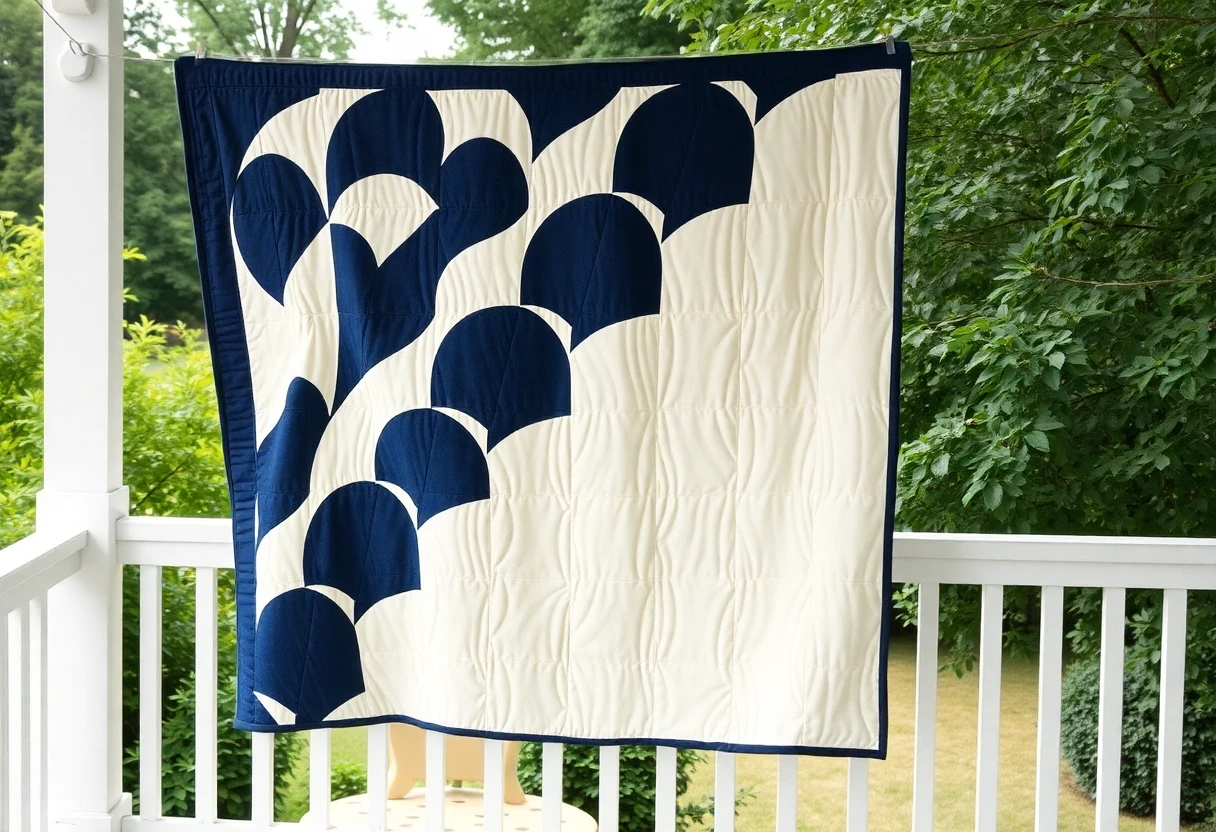 Drunkard's path quilt blockOne quarter-circle unit, a curved seam sewn with pins, and eight layouts from the same pieces.