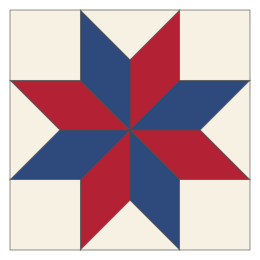
The pieces

Every diamond side has the same length, and so does each corner square. Along one edge of the block you have a corner square, the long side of a triangle, and another corner square. The triangle's long side is the diamond side × 1.414, so the block is the diamond side × 3.414. That number is never a whole fraction, which is why LeMoyne charts are sized by the diamond strip instead of the block.
Cutting chart (one block)
| Diamond strip width | Finished block | Diamond side (finished) | Background: corners | Background: side triangles | Strip length for 8 diamonds | Block before trimming |
|---|---|---|---|---|---|---|
| 2 in | 7.24 in (about 7¼) | 2.12 in | 4 squares 2⅞ in | 1 square 4½ in, cut twice | 25 in | about 7¾ in |
| 2½ in | 9.66 in (about 9⅝) | 2.83 in | 4 squares 3⅝ in | 1 square 5½ in, cut twice | 31 in | about 10⅛ in |
| 3 in | 12.07 in (about 12⅛) | 3.54 in | 4 squares 4⅜ in | 1 square 6½ in, cut twice | 37 in | about 12⅝ in |
| 3½ in | 14.49 in (about 14½) | 4.24 in | 4 squares 5 in | 1 square 7½ in, cut twice | 44 in (two strips) | about 15 in |
The math behind the chart: the finished diamond is the strip width minus ½ inch measured across, its side is that number × 1.414, and the finished block is 4.83 × (strip width − ½). A 3-inch strip gives a 12.07-inch block. The corner squares and side triangles are cut slightly oversized on purpose (exact sizes are 2.62, 3.33, 4.04 and 4.74 inches for the squares, and 4¼, 5¼, 6¼ and 7¼ inches for the triangle squares), so you trim the finished block square instead of trying to set in a piece that's exactly right. The strip lengths allow for the angled first cut. For a two-color star, cut half the length from each color: 4 diamonds need 14, 17, 20 or 24 inches of strip. Every size here was checked by calculation.
The side triangles are quarter-square triangles: cut the square on both diagonals. That puts the straight grain on their long edge, which is the outside edge of the block, so the block doesn't stretch.
Cutting the diamonds
- Cut a strip the width in the chart, across the width of the fabric. Fold it in half if you're cutting all eight diamonds from one fabric; cut each color separately for a two-color star.
- Lay the strip horizontally. Put the 45-degree line of your ruler on the bottom edge of the strip and cut off the end at an angle. The scrap is waste.
- Move the ruler along the strip so its strip-width line (3 inches for a 3-inch strip) sits exactly on the angled cut, with the 45-degree line still on the strip edge. Cut. That's one diamond with four equal sides.
- Repeat for all eight. Check one: all four sides should measure the same, about 4.24 inches for a 3-inch strip (that's the cut size, the strip width × 1.414).
The diamonds' long sides are on the bias, so handle them by the points and don't press them until they're sewn. A light spray starch on the strip before cutting helps a lot.
Mark the quarter-inch points
Every set-in seam starts or stops exactly ¼ inch from the edge, never at the edge. On the wrong side of each diamond, mark a dot ¼ inch in from both edges at the wide corners (the two 135-degree corners). Mark the inside corner of each corner square and the right-angle corner of each triangle the same way. It takes ten minutes. Skip it and you'll be guessing where every Y-seam stops.
Sewing the star
- Sew diamonds in pairs: put two diamonds right sides together, one of each color, and sew along one long side from the center point to the dot. Backstitch at the dot. Don't sew into the seam allowance. Make four pairs, all with the colors in the same order.
- Press each pair's seam to one side, always the same direction (clockwise around the star works).
- Sew two pairs into a half star, again stopping at the dot, then the other two. You now have two halves of four diamonds each.
- Join the halves across the middle. Pin through the center point first: push a pin through the exact point where all the diamond tips meet on both halves. Sew from dot to dot, straight through the center. Press this seam open; it's the thickest spot in the block.
- Check the star: it should lie flat. If the center bubbles, one seam is too wide; if there's a hole, one is too narrow. Fix it now, before any background goes in.
Setting in the corners and triangles (the Y-seams)
- Lay the star right side up. Take a corner square and put it right sides together with one diamond, the square's marked corner on the diamond's dot. Sew from the outer edge to the dot and backstitch. Stop with the needle exactly on the dot.
- Lift the presser foot, pivot the square so its other side lines up with the neighboring diamond, folding the diamonds' seam allowance out of the way. Sew from the dot out to the edge.
- Repeat with the other three squares in the corners and the four triangles at the sides, alternating. Each piece takes two short seams that meet at a dot.
- Press the seams toward the background pieces. At each Y, the three seam allowances should swirl around the dot instead of folding over each other.
- Trim the block square, leaving ¼ inch beyond each diamond tip at the edges. For a 3-inch strip, that's about 12⅝ inches.
Some quilters sew the background pieces in by hand. Hand piecing handles Y-seams well, because each seam ends exactly where you knot it; our English paper piecing guide uses the same idea with paper shapes.
Common mistakes and fixes
| Problem | Cause | Fix |
|---|---|---|
| Pucker at an inside corner | Seam sewn past the ¼-inch dot | Unpick two or three stitches back to the dot and press again |
| Hole at an inside corner | Seam stopped short of the dot | Restitch to the dot with a short backstitch |
| Center lumps up like a volcano | Diamonds cut a little big, or seams narrow | Check the cut diamonds against each other; sew a true ¼ inch |
| Center doesn't meet | Halves joined without pinning at the center | Pin through the center point on both halves before sewing |
| Block wavy at the edges | Bias edges stretched while pressing | Starch first and press with an up-and-down motion |
Quilts made from LeMoyne stars
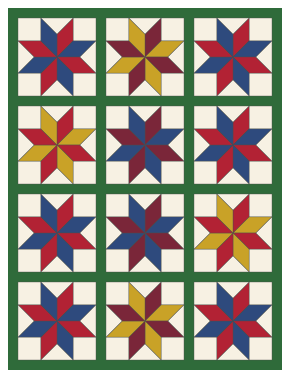
Because the block size isn't a round number, sashing is the easiest setting: trim all the blocks to the same size and cut the sashing to match the trimmed blocks, not the chart. Eight-pointed stars in red and green on cream make a traditional Christmas quilt, and in red and navy they belong in a patriotic one.
Related blocks
If you'd rather skip set-in seams, the sawtooth star and Ohio star are both eight-pointed stars made only from straight seams, with flying geese and quarter-square triangles for points. Those two have grid-based sizes that the block resizer and half-square triangle calculator can work out for you. Every block on the site is in the quilt block library.
You might also like
 Ohio star quilt blockAn eight-point star from quarter-square triangles, cut for 6, 9 and 12 inch blocks.
 Churn dash quilt blockHalf-square triangle corners and two-strip bars, cut for 6, 9 and 12 inch blocks.
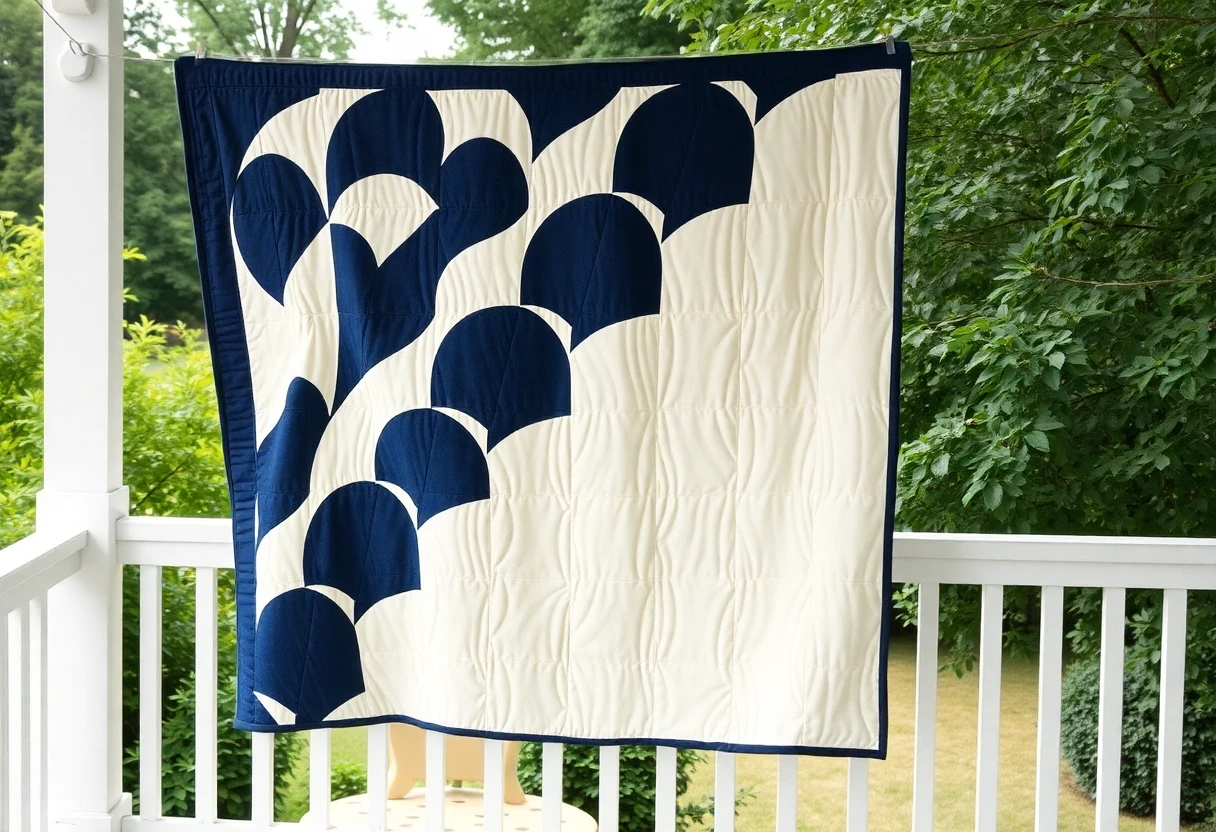 Drunkard's path quilt blockOne quarter-circle unit, a curved seam sewn with pins, and eight layouts from the same pieces.
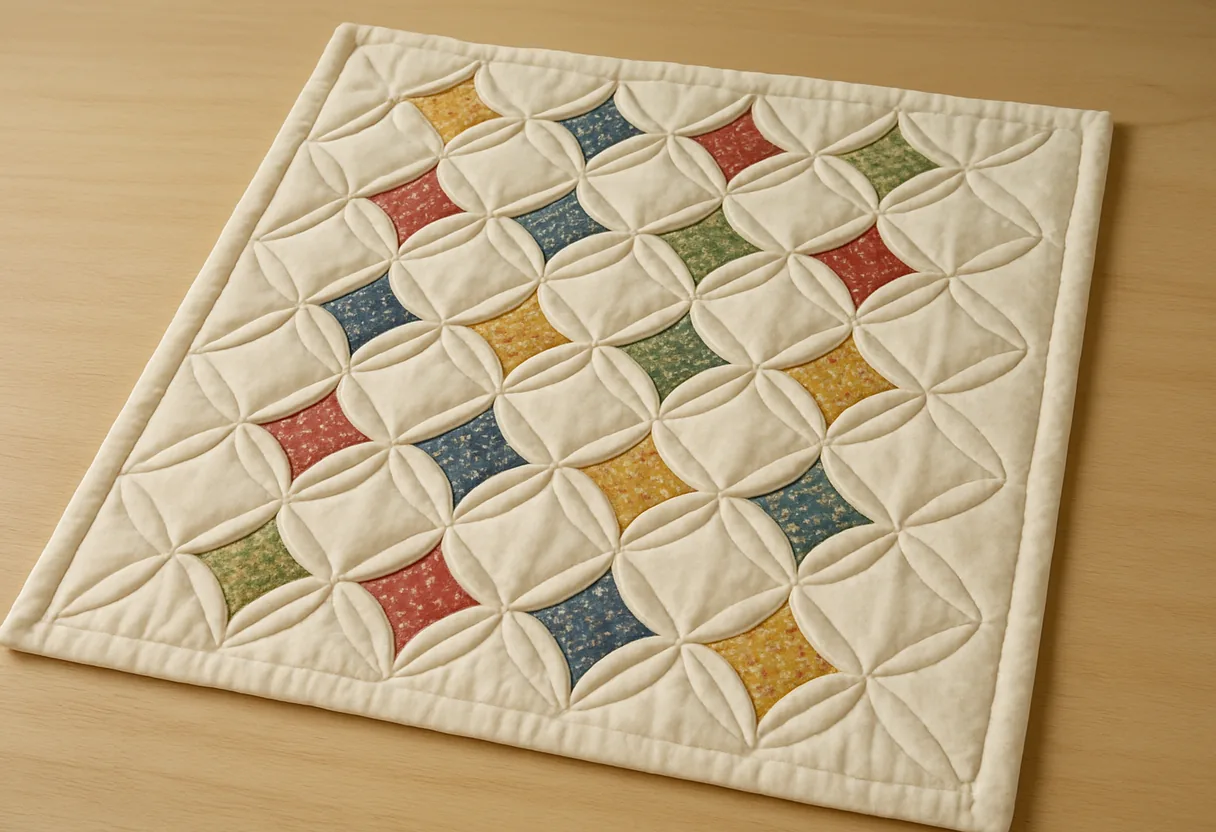 Cathedral window quiltThe folded block step by step, with a size chart, the window math and a 17-inch pillow worked out.