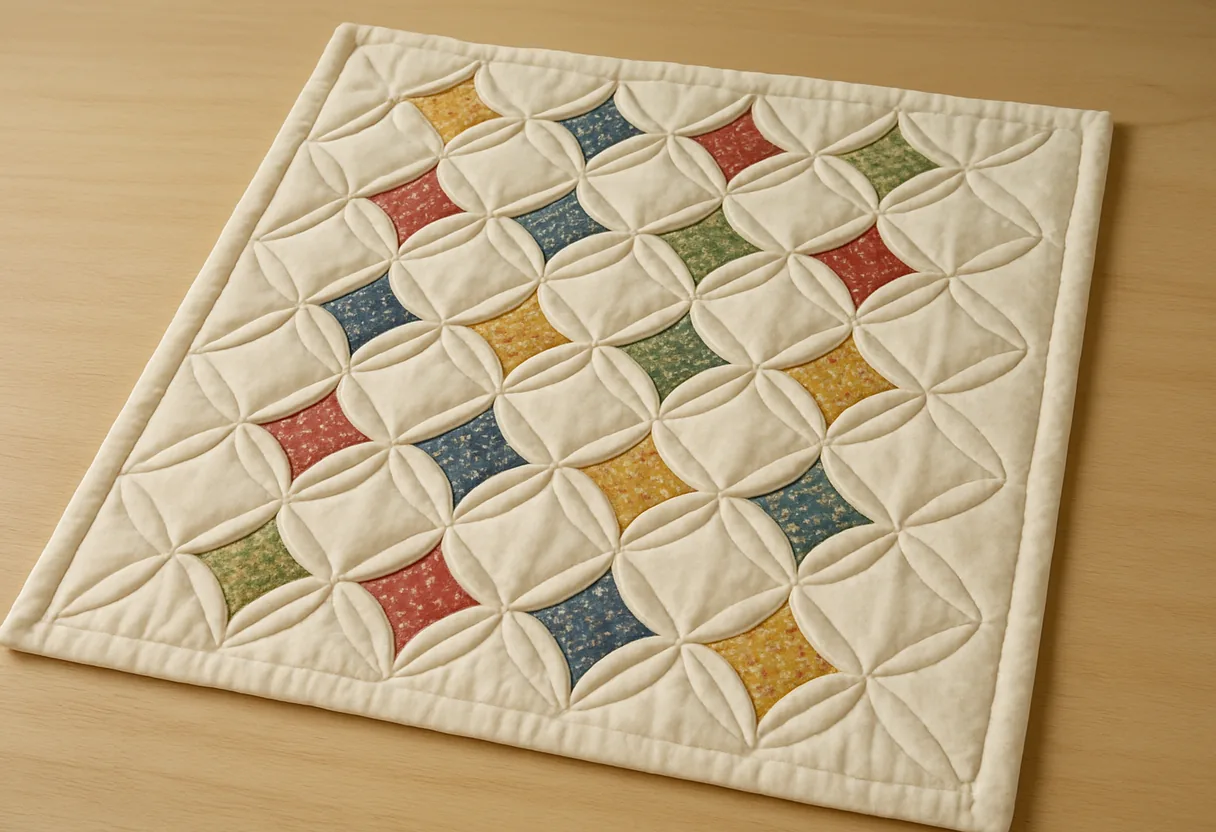
How the folding works

Folding the four corners of a square to its center gives a square half the area, turned on point. Folding the corners in again halves the area once more and turns it back square: the finished unit is half as wide as the square you started with. Pressing a ¼-inch hem around the edge first takes another ½ inch off the starting size, so:
finished unit = (cut square − ½ in) ÷ 2
When two units sit side by side, the folded flaps around the seam form a diamond: its corners are the two units' centers and the two ends of the seam. Each side of that diamond is the unit size divided by 1.414. The window square has to fit inside it, so cut windows about ⅛ inch smaller than the diamond's side.
| Cut background square | Finished unit | Diamond side | Cut window square |
|---|---|---|---|
| 7 in | 3¼ in | 2.30 in | 2⅛ in |
| 8 in | 3¾ in | 2.65 in | 2½ in |
| 9 in | 4¼ in | 3.01 in | 2⅞ in |
| 10½ in | 5 in | 3.54 in | 3⅜ in |
All sizes are checked by calculation. Fabrics vary in thickness, so fold one test unit and lay a window on it before cutting all the windows.
Worked example: a 17-inch pillow front
Sixteen 9-inch background squares, folded, make a panel 4 units by 4: 17 × 17 inches (4 × 4¼). Inside it there are 24 seams between units (3 in each of the 4 rows, and 3 between the rows in each of the 4 columns), so 24 windows.
| Fabric | Cut | Amount |
|---|---|---|
| Background (a light solid or tone-on-tone) | 16 squares, 9 in | 1 yd (4 strips 9 in wide, 4 squares per 40-in strip) |
| Windows (scraps, or one print) | 24 squares, 2⅞ in | ¼ yd, or scraps at least 3 in square |
A bed-size cathedral window takes hundreds of units and a lot of background fabric (each unit uses more than four times its own area in cloth), which is why most people start with a pillow, a table runner or a wall piece.
Step by step
- Cut the background squares on the straight grain, exactly square. A square that's off by ⅛ inch makes a unit that's off by half that, and the error builds along a row.
- Press a ¼-inch hem to the wrong side on all four edges. A cardboard template cut to the inner size (8½ inches for a 9-inch square) makes this fast: lay it on the wrong side and press the edges over it.
- Fold all four corners to the center, wrong sides together, and press. The square is now on point, with the hems tucked inside.
- Fold the four new corners to the center again and press. Tack the four points together at the center with a couple of small stitches through all the layers, using matching thread. Some quilters add a small button or a cross-stitch here instead.
- Join the units. Put two units together with their flat backs facing out (folded sides together) and whipstitch along one edge with small stitches, catching only the folded edges. Join units into rows, then rows into the panel, matching the corners.
- Pin a window square on point over each seam, inside the diamond formed by the flaps.
- Roll the folded edge of one flap over the raw edge of the window, so it curves: most at the middle of the side (about ⅛ inch), and none at the corners. Blind-stitch or slip-stitch the roll down through the window and the layer below, but not through to the back.
- Work around all four sides of each window. At each corner where two rolled edges meet, take two or three stitches across both to tack them together tightly.
- Along the outer edges, the half diamonds have no neighbor. Leave them plain, roll and tack them as a scallop, or tuck a small triangle of window fabric into each one and stitch it the same way.
Finished look and variations
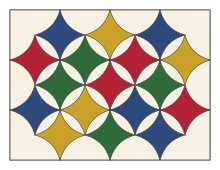
- Secret garden: leave some diamonds empty, so the rolled background frames show alone and the windows make a pattern.
- Machine method: many quilters fold each square in half, sew the ends, and turn it to make the first fold, which replaces the pressed hem. The rest is the same.
- Faux cathedral window: a pieced or quilt-as-you-go version that uses circles folded over squares. It looks similar with less fabric, but it's a different technique.
- Memory version: windows cut from a loved one's shirts or dresses. Each window needs only a 3-inch scrap, so even a single blouse gives dozens.
Common problems
| Problem | Cause | Fix |
|---|---|---|
| Units different sizes | Squares not cut square, or hems uneven | Use a pressing template for the hems and check each unit before joining |
| Window edges peek out | Window too big, or the roll too shallow | Trim the window ⅛ inch, or roll the fold a little further at the middle |
| Window floats loose | Window too small for the diamond | Cut the next ones bigger, closer to the diamond's side |
| Corners of the frames gap | No tack where the rolled edges meet | Take two or three firm stitches across each corner |
| Panel ripples | Whipstitching pulled tight | Use small, even stitches without tension, and press the joined rows gently |
The hand stitches here are the same ones used for needle-turn applique. For another hand-sewn technique that uses no batting and folded edges, see English paper piecing, or for a curved block that is pieced instead of folded, the double wedding ring.
You might also like
 Double wedding ring quiltThe four pieces of the ring, why it's a challenge, free true-size templates for 10-inch rings, counts by quilt size and the assembly order.
 How to make half-square trianglesThe 2-, 4- and 8-at-a-time methods, a cut-size chart for each and how to trim.
 LeMoyne star quilt blockEight 45-degree diamonds with set-in corners, sized by strip width, with every Y-seam step.
 Economy quilt block (square in a square)A center square framed by two rounds of triangles, with cut sizes for 4, 6, 8 and 12 inch blocks.