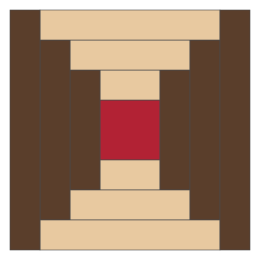
How the block grows
Each round adds two logs to the top and bottom, then two to the sides. The top and bottom logs are as long as the unit is wide at that moment; the side logs are as long as the unit is tall after the top and bottom go on. Each round makes the block two log widths bigger in both directions, so a block is the center plus 2 × log width × rounds. A 2-inch center with three rounds of 1-inch logs is 2 + 6 = 8 inches.
Because both logs in each pair are the same length, courthouse steps has only half as many different lengths to cut as a classic log cabin, and the block stays symmetric from the first round, which makes it easier to keep square.
Cutting lists (one block, in sewing order)
Cut all logs from strips the finished log width + ½ inch. Every log is listed at its cut length; cut two of each.
| Block | Center | Strip width | Round 1 | Round 2 | Round 3 |
|---|---|---|---|---|---|
| 6 in (2 rounds) | 2½ in square | 1½ in | light 2½, dark 4½ | light 4½, dark 6½ | none |
| 8 in (3 rounds) | 2½ in square | 1½ in | light 2½, dark 4½ | light 4½, dark 6½ | light 6½, dark 8½ |
| 12 in (3 rounds) | 3½ in square | 2 in | light 3½, dark 6½ | light 6½, dark 9½ | light 9½, dark 12½ |
"Light 2½, dark 4½" means two light logs 2½ inches long (top and bottom), then two dark logs 4½ inches long (sides). Per block, the 6-inch block uses 14 inches of light strip and 22 of dark, the 8-inch block 27 and 39, and the 12-inch block 39 and 57. The dark side always uses more, because the side logs are longer. Every length here was worked out by calculation, round by round, and each block comes out at the finished size + ½ inch (6½, 8½ or 12½).
For other centers, log widths or round counts, the log cabin calculator has a courthouse steps option that lists every log in order with strips and yardage. The 12-inch version above uses the same 3-inch center and 1½-inch logs as our log cabin quilt pattern, so you can make both from the same strips.
Piecing steps
- Sew a light log to the top and the bottom of the center square. Press both seams away from the center. Every seam in this block is pressed away from the center.
- Sew a dark log to each side. They should run the full height of the unit, covering the ends of the light logs. Press away from the center.
- Measure the unit. After round 1 of the 12-inch block it should be 6½ inches square. If it's off, fix it now; errors grow with every round.
- Repeat rounds 2 and 3 the same way: light top and bottom, dark sides.
- Measure the finished block and square it up if needed, trimming evenly from all four sides.
A faster way that skips cutting logs to length: sew a long strip across the top of a row of centers and cut between them. Press, then repeat on the bottom and on the sides. Chain piecing a stack of blocks this way goes quickly once the first round is done. It's the same "sew and trim" approach the log cabin pattern describes.
Choosing fabrics
Use two clearly different values: a group of lights and a group of darks. Within each group the logs can be scraps, as in the quilt diagram below, as long as every light is lighter than every dark. A strong center color (red is the traditional log cabin choice) gives the eye a place to land in every block.
Common mistakes and fixes
- Block not square. A seam was wider on one side than the other, or a log was stretched. Measure after each round, and press with an up-and-down motion.
- Lights and darks in the wrong place. Logs were added clockwise like a classic log cabin. In courthouse steps it's always a pair: top and bottom, then both sides.
- Logs too short. The unit had grown a little, so logs cut to the chart fell short. Use the sew-and-trim method, or cut logs to the measured unit size.
- Rippled edges. The final logs were eased in. Measure through the middle and cut the last logs to that length.
Quilts made from courthouse steps
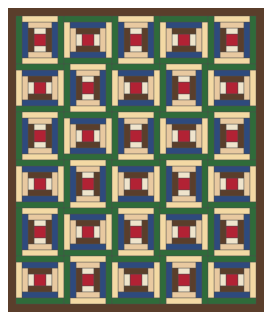
With all the blocks turned the same way, the dark side logs of neighboring blocks line up into columns and the lights into rows. Turning every other block a quarter turn, as above, makes a woven look. For the 30-block quilt in 12-inch blocks you need 30 centers (3 strips 3½ inches wide) and logs cut from 2-inch strips: about 31 light strips and 45 dark strips if each length is cut from its own strips, a few fewer if you mix lengths along a strip. Counts use 40 usable inches of fabric width.
Strips cut from shirts or dresses fit the logs easily, so courthouse steps works well for a memory or keepsake quilt; our guide to memory quilts from clothes covers preparing garment fabric.
Related blocks
For the classic version with logs added in a spiral, see the log cabin quilt pattern. Other blocks that grow from the center out are the economy block and the snail's trail. The log cabin calculator handles any size, and the quilt block library shows every block on the site.
You might also like
 Dutchman's puzzle quilt blockEight flying geese in pairs turning around the center, cut for 6, 8, 12 and 16 inch blocks.
 Log cabin block calculatorEvery log length in sewing order and the yardage, for log cabin and courthouse steps.
 Ohio star quilt blockAn eight-point star from quarter-square triangles, cut for 6, 9 and 12 inch blocks.
 Churn dash quilt blockHalf-square triangle corners and two-strip bars, cut for 6, 9 and 12 inch blocks.