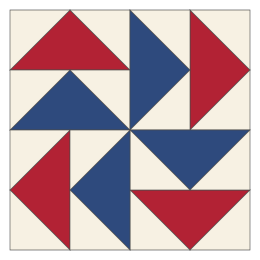
How the block is built
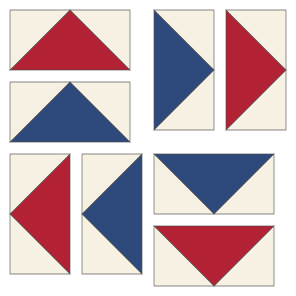
The block is a 4 × 4 grid. Each goose is 2 grid squares wide and 1 tall, so a 12-inch block uses 3 × 6-inch geese, and two geese stacked make a 6-inch square. In the top-left quarter both geese point up, toward the block edge. Turn that quarter clockwise around the center and you get the other three, pointing right, then down, then left.
In the classic version the large goose triangles are the print and the small sky triangles are background. Two prints for the geese (one for the outer goose of each pair, one for the inner) give the strongest spin.
Cutting chart (one block, no-waste geese)
| Finished block | Finished goose | Goose fabric: large squares | Background: small squares | Goose trims to | Unfinished block |
|---|---|---|---|---|---|
| 6 in | 3 × 1½ in | 2 squares 4¼ in (1 of each goose fabric) | 8 squares 2⅜ in | 3½ × 2 in | 6½ in |
| 8 in | 4 × 2 in | 2 squares 5¼ in (1 of each goose fabric) | 8 squares 2⅞ in | 4½ × 2½ in | 8½ in |
| 12 in | 6 × 3 in | 2 squares 7¼ in (1 of each goose fabric) | 8 squares 3⅞ in | 6½ × 3½ in | 12½ in |
| 16 in | 8 × 4 in | 2 squares 9¼ in (1 of each goose fabric) | 8 squares 4⅞ in | 8½ × 4½ in | 16½ in |
One large square and four small squares make four identical geese, so two large squares (one red, one navy) and eight small ones make the eight geese for one block. The rule: large square = finished goose width + 1¼ inches, small squares = finished goose height + ⅞ inch. Those are exact. To trim instead, cut the large squares ¼ inch bigger and the small ones ⅛ inch bigger. Checked by calculation for every size listed.
For one goose at a time instead, use stitch-and-flip: for each goose cut one rectangle at the trim size above in the goose fabric and two background squares the height of that rectangle (2, 2½, 3½ or 4½ inches). Our flying geese guide walks through both methods with diagrams.
Making the geese
- Draw a diagonal line on the wrong side of each small background square.
- Place two small squares on opposite corners of a large square, right sides together, lines joined into one diagonal. Sew ¼ inch on both sides of the line and cut on it.
- Press the small triangles out. On each piece, put a small square in the remaining corner, line running from the corner to the gap between the two small triangles. Sew both sides, cut, press.
- Repeat with the second large square. Trim all eight geese to the same size, with the goose tip centered and ¼ inch from the top edge.
Sewing the block
- Make four pairs: sew a red goose on top of a navy goose, both pointing the same way, with the tip of the lower goose touching the seam. Sew with the lower goose on top so you can see its tip, and stitch just above it (a thread toward the raw edge).
- Press the seam toward the upper goose, away from the point, so the tip stays flat.
- Lay out the four pairs. Top left: geese pointing up. Top right: pointing right. Bottom right: pointing down. Bottom left: pointing left. In every quarter, both geese point toward the block edge.
- Sew the top two quarters together and the bottom two together. Press the top row seam one way and the bottom the other.
- Join the halves. Eight points meet at the center; pin through the center from both sides first. Press the last seam open, or swirl the center seams (unpick the two or three stitches inside the seam allowance at the center so the seams fan out in a little pinwheel).
- Measure: 6½, 8½, 12½ or 16½ inches.
Common mistakes and fixes
| Problem | Cause | Fix |
|---|---|---|
| One quarter spins the wrong way | A pair turned 180 degrees | Check every pair against the diagram before sewing the halves |
| Goose tips cut off | Seam sewn below the tip | Sew with the tip visible and stitch just to the outside of it |
| Pairs aren't square | Geese trimmed to different heights | Trim all eight to the same size before pairing |
| Lump in the middle | Eight seam allowances stacked at the center | Press the center open or swirl it |
Quilts made from Dutchman's puzzle
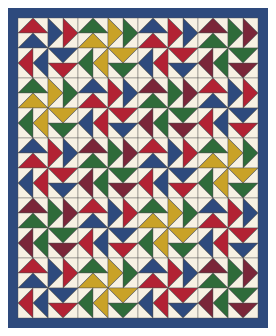
Set side by side with no sashing, the geese of neighboring blocks run into each other at the block edges, so the quilt reads as a field of motion more than a grid of blocks. Sashing does the opposite: each block becomes a separate spinning square. It's a good scrap quilt: each block needs only two goose fabrics, and a 7¼-inch square fits in almost any leftover piece. A 20-block quilt in the size above uses 160 geese, which is a good reason to learn the no-waste method.
Related blocks
The pinwheel spins the same way with half-square triangles instead of geese, and the sawtooth star uses four of the same geese around a center square. For any goose size, see the flying geese guide; for triangle squares, the half-square triangle calculator. The block resizer explains which block sizes keep the cuts on ruler lines, and the quilt block library shows every block on the site.
You might also like
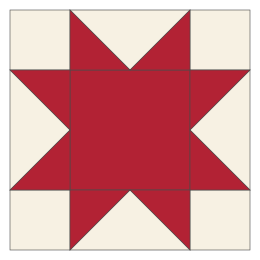 Sawtooth star quilt blockA big center square and four flying geese points, cut for 6, 8, 12 and 16 inch blocks.
 Pinwheel quilt blockFour half-square triangles turned around the center, cut for 4, 6, 8, 10 and 12 inch blocks.
 Bear's paw quilt blockFour paws of 16 triangle claws around a sashing cross, cut for 7, 10½ and 14 inch blocks.
 Sister's choice quilt blockA five-patch with a nine-patch center and eight triangle points, cut for four sizes.