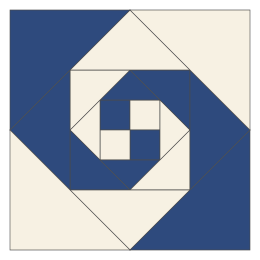
How the block grows

Each round adds a triangle to every side of the unit, which makes the new unit 1.414 times bigger. Four rounds multiply the four-patch by 4, so the four-patch is always a quarter of the finished block: a 12-inch snail's trail starts from a 3-inch four-patch. After rounds 2 and 4 the size is a whole fraction; after rounds 1 and 3 it isn't, so those rounds are cut a little big and trimmed to the points.
The color rule
Start with the four-patch turned so its dark squares are top left and bottom right. Then, for every round, work clockwise around the unit: each new triangle takes the color of the piece at the start of its side. On the first round, the top side starts at the dark top-left square, so its triangle is dark; the right side starts at the light top-right square, so its triangle is light; and so on. The darks always land on two opposite sides, and the spiral keeps turning the same way. Lay out each round next to the machine before sewing it.
Cut sizes (one block)
| Finished block | Four-patch | Triangle squares, rounds 1 / 2 / 3 / 4 | Unit after each round (trim to) |
|---|---|---|---|
| 8 in | 4 squares 1½ in (2 dark, 2 light) | 2½ / 2⅞ / 3⅞ / 4⅞ in | about 3⅜ / 4½ / about 6⅛ / 8½ in |
| 12 in | 4 squares 2 in (2 dark, 2 light) | 3⅛ / 3⅞ / 5¼ / 6⅞ in | about 4¾ / 6½ / about 9 / 12½ in |
| 16 in | 4 squares 2½ in (2 dark, 2 light) | 3⅞ / 4⅞ / 6¾ / 8⅞ in | about 6⅛ / 8½ / about 11⅞ / 16½ in |
For each round cut one dark square and one light square at the size listed and cut each once on the diagonal: two dark triangles and two light. That's 8 squares plus the four-patch for the whole block.
The math: each triangle's short sides equal the finished side of the unit it's sewn to ÷ 1.414, and the square to cut is that + ⅞ inch. For rounds 2 and 4 that's exact (the 8-inch block's round 2 triangles sit on a 2.83-inch unit and need 2⅞-inch squares). For rounds 1 and 3 the exact size isn't on a ruler line, so the chart adds ⅛ inch and rounds up to the next ⅛ inch, leaving a little to trim. The "about" trim sizes are approximate; trim to the points instead, leaving ¼ inch beyond each corner of the previous round. Every size was checked by calculation, and the sizes after rounds 2 and 4 come out at exactly the four-patch × 2 and × 4 (+ ½ inch).
Piecing steps
- Four-patch: sew a dark and a light square together twice, press toward the dark, and join the pairs with the darks diagonally opposite. Press. It should measure the finished four-patch + ½ inch (2½, 3½ or 4½ inches).
- Round 1: crease the middle of each triangle's long edge. Following the color rule, sew triangles to two opposite sides of the four-patch, matching each crease to the four-patch's center seam. Press out. Add the other two. Press.
- Trim the unit: each side has one corner of the four-patch at its middle. Put the ruler's ¼-inch line on that corner, with the ruler's edge along the side, and trim. Repeat on all four sides.
- Round 2: the sides of the new unit have the round 1 triangle tips at their ends and a four-patch corner at their middles. Crease the round 2 triangles and match each crease to the four-patch corner. Follow the color rule. Press and trim to the size in the chart (4½, 6½ or 8½ inches).
- Rounds 3 and 4: the same again. After round 4 the block should measure 8½, 12½ or 16½ inches.
Spray starch helps a lot: every round is sewn to the bias edges of the round before. Press with an up-and-down motion and handle the units by their straight edges.
Many quilters foundation piece snail's trail instead, sewing on a paper pattern so the bias can't stretch. The rotary-cut method here needs no pattern at all, as long as you trim each round.
Common mistakes and fixes
- The spiral changes direction partway out. One round got its colors swapped. Use the color rule every round, starting from the dark squares of the four-patch.
- Points cut off at the edge of a round. The unit was trimmed to the chart number instead of to the points. Trim ¼ inch beyond the corners every time.
- Block twisted, not square. A round's triangles were sewn off-center. Crease and match the middles.
- Final block too small. Round 4 cut at the exact size with a slightly wide seam. Cut round 4 squares ⅛ inch bigger and trim.
Quilts made from snail's trail blocks
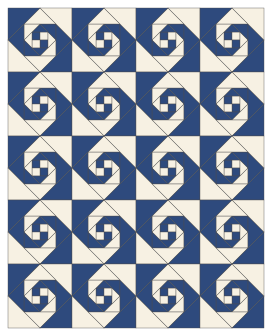
When blocks touch, the round 4 triangles of neighboring blocks meet, and the dark arms of one block run into the dark arms of the next, so the arms connect into an all-over pattern of interlocking spirals. That only works with no sashing and every block turned the same way. In two colors the effect is strongest; in scraps, keep one fabric group for all the darks and one for all the lights.
Snail's trail is a slower block than most on this site (20 pieces and a trim after every round), which makes a full quilt of them a real gift of time. A smaller project is a wall hanging of four 16-inch blocks, 32 inches square before borders; see how to hang a quilt.
Related blocks
Snail's trail starts like the economy block, which has the same rounds in single colors and fewer of them. For another block whose design only appears in the quilt, see the storm at sea; for a spin made from triangle squares, the pinwheel. The square in a square calculator and half-square triangle calculator help with other sizes, the block resizer explains grid sizing, and the quilt block library shows every block on the site.
You might also like
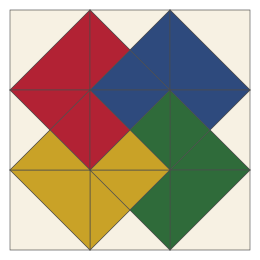 Card trick quilt blockFour "cards" that seem to overlap, from half and quarter triangles, cut for 6, 9 and 12 inch blocks.
 Jacob's ladder quilt blockFive four-patches and four triangle squares that link into diagonal ladders, cut for 6, 9 and 12 inch blocks.
 Economy quilt block (square in a square)A center square framed by two rounds of triangles, with cut sizes for 4, 6, 8 and 12 inch blocks.
 Pinwheel quilt blockFour half-square triangles turned around the center, cut for 4, 6, 8, 10 and 12 inch blocks.