
How the block is built
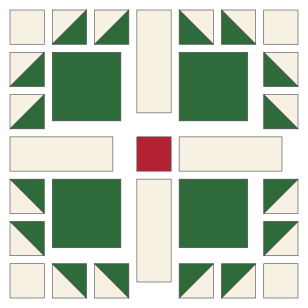
The grid is 7 × 7. Call one grid square u: the finished block divided by 7. Each paw is 3 × 3 u: a 2 × 2 u paw square toward the middle, two claw HSTs along the top, two down the outer side, and a 1 u background square in the corner where the claw rows meet. Between the paws are four background rectangles, 1 × 3 u, and a 1 u center square.
Seven-patch blocks don't land on round numbers at the usual 6, 9 or 12 inches. The easy sizes are multiples of 3½: 7 inches (1-inch grid), 10½ (1½-inch grid) and 14 (2-inch grid).
Cutting chart (one block)
| Finished block | Grid square | Paw: large squares | Claw HSTs: paw + background squares | Background: corners and sashing | Center | Unfinished block |
|---|---|---|---|---|---|---|
| 7 in | 1 in | 4 squares 2½ in | 8 pairs 1⅞ in (or 2 in to trim) | 4 squares 1½ in, 4 rectangles 1½ × 3½ in | 1 square 1½ in | 7½ in |
| 10½ in | 1½ in | 4 squares 3½ in | 8 pairs 2⅜ in (or 2½ in to trim) | 4 squares 2 in, 4 rectangles 2 × 5 in | 1 square 2 in | 11 in |
| 14 in | 2 in | 4 squares 4½ in | 8 pairs 2⅞ in (or 3 in to trim) | 4 squares 2½ in, 4 rectangles 2½ × 6½ in | 1 square 2½ in | 14½ in |
"8 pairs" means 8 squares of paw fabric and 8 of background, which make 16 HSTs two at a time. Trim each HST to u + ½ inch (1½, 2 or 2½ inches). The 1-inch claws of a 7-inch block are fiddly, so make your first one at 10½ or 14 inches. All sizes were checked by calculation, and the pieces fill the 49-square grid exactly.
Eight at a time is faster for claws: two pairs of squares (paw and background) cut at 3¾, 4¾ or 5¾ inches (exact) or 4, 5 or 6 inches (to trim) give all 16. The half-square triangle guide explains the method, and the half-square triangle calculator works out other claw sizes.
Step 1: make the claws
- Draw a diagonal on the wrong side of each background HST square. Pair it with a paw square, right sides together.
- Sew ¼ inch on both sides of the line, cut on the line, press toward the paw fabric.
- Trim all 16 to the same size. Small HSTs are the ones that drift, so trim every one, even if you cut exact.
Step 2: sew four paws
- Claw row: sew two HSTs side by side so the paw triangles sit along the bottom edge, each with its diagonal running from upper right to lower left. Sew a small background square to the left end. Press toward the square.
- Claw column: sew two HSTs one above the other, turned so the paw triangles sit along the right edge, against the paw square, with the same diagonal direction. Press in the opposite direction from the claw row.
- Sew the claw column to the left side of the large paw square. Press toward the paw square.
- Sew the claw row to the top, matching the seam where the column meets the square. Press toward the paw square.
- Check: the small background square is in the top-left corner and every claw points away from the paw square. The paw unit measures 3u + ½ inch (3½, 5 or 6½ inches). Make four.
All four paws are identical. They only look different in the block because each is turned to put its background corner square at a block corner.
Step 3: assemble the block
- Lay out three rows: paw, sashing rectangle, paw / rectangle, center square, rectangle / paw, rectangle, paw. Turn each paw so its small background square is at the outer corner of the block.
- Sew the rows. Press toward the sashing rectangles in the paw rows and toward the rectangles in the middle row too, away from the center square.
- Join the rows, matching the seams where the sashing strips meet the center square. Press the long seams toward the sashing.
- Measure: 7½, 11 or 14½ inches.
Common mistakes and fixes
| Problem | Cause | Fix |
|---|---|---|
| Claws point in two directions | One HST in a row turned the other way | Both diagonals in a claw row run the same way; check before sewing |
| Claw row longer than the paw square | HSTs not trimmed, or a wide seam | Trim all HSTs; the row of two must match the paw square side |
| Background corner square in the middle of the block | A paw rotated before sewing into a row | Corner squares go to the four outer corners |
| Cross doesn't line up | Rows pressed the same way | Press the paw rows and middle row so the seams nest |
Quilts made from bear's paw blocks
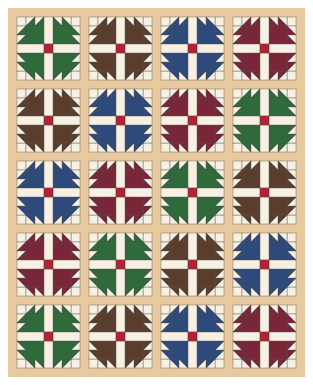
Bear's paw is usually set with sashing. Cut it from the same fabric as the cross inside the block and the strips seem to run straight through the blocks as one lattice. Earthy greens and browns on cream give it a cabin look; a single dark color in every paw on a light background is the most graphic version. The 14-inch block makes a big quilt from few blocks, which suits a first seven-patch project. Twenty blocks need 320 claws, and that's where the eight-at-a-time method earns its keep.
Related blocks
The other seven-patch block in our library is the triple Irish chain. For a smaller grid with corner triangles, try the churn dash or sister's choice. The quilt block resizer explains grid math for other sizes, and the quilt block library shows every block on the site.
You might also like
 Jacob's ladder quilt blockFive four-patches and four triangle squares that link into diagonal ladders, cut for 6, 9 and 12 inch blocks.
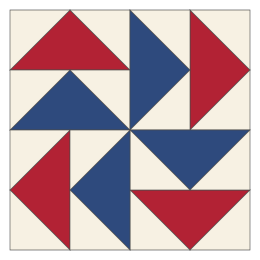 Dutchman's puzzle quilt blockEight flying geese in pairs turning around the center, cut for 6, 8, 12 and 16 inch blocks.
 Pinwheel quilt blockFour half-square triangles turned around the center, cut for 4, 6, 8, 10 and 12 inch blocks.
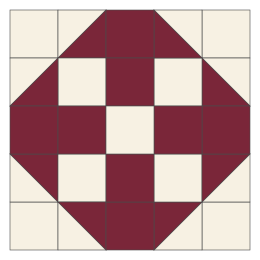 Sister's choice quilt blockA five-patch with a nine-patch center and eight triangle points, cut for four sizes.