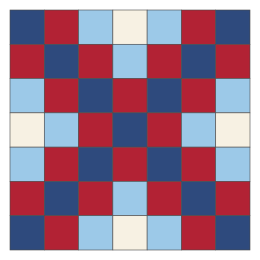
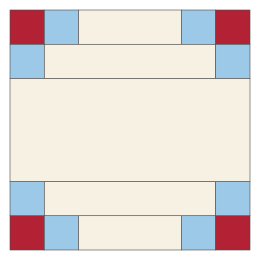
How the chains link
In block A, every square is colored by how far it is from the nearest diagonal: on the diagonal it's dark (navy), one square away it's medium (red), two away it's the light chain color (light blue), and three away it's background. The navy X runs from corner to corner, so it passes straight into the next chain block diagonally. The red and light blue lines run off the sides of the block instead, and block B picks them up in its corners and hands them on to the next A block. That's the whole design. The double Irish chain pattern works the same way with a 5 × 5 block and two chain colors.
Cutting chart (one block of each)
| Finished block | Square (finished) | Cut squares and strips | Block A | Block B |
|---|---|---|---|---|
| 7 in | 1 in | 1½ in | 13 navy, 20 red, 12 light blue, 4 cream squares | 4 red + 8 light blue squares 1½ in; cream 7½ × 3½, two 5½ × 1½ and two 3½ × 1½ in |
| 10½ in | 1½ in | 2 in | 13 navy, 20 red, 12 light blue, 4 cream squares | 4 red + 8 light blue squares 2 in; cream 11 × 5, two 8 × 2 and two 5 × 2 in |
| 14 in | 2 in | 2½ in | 13 navy, 20 red, 12 light blue, 4 cream squares | 4 red + 8 light blue squares 2½ in; cream 14½ × 6½, two 10½ × 2½ and two 6½ × 2½ in |
Each block measures the finished size + ½ inch before it's sewn in (7½, 11 or 14½ inches). Start with the 10½-inch block (2-inch strips): 2-inch strips are easy to handle and the quilt grows fast. All counts and sizes were checked by calculation: 13 + 20 + 12 + 4 = 49 squares in block A, and block B's pieces add up to the same 7 × 7 area.
Block A from four strip sets
Block A has only four different rows, and the bottom three mirror the top three. Make one strip set for each row type, cut it into segments the strip width, and stack the segments.
| Row | Strips, left to right | Used in rows | Segments per block |
|---|---|---|---|
| Row 1 | navy, red, light blue, cream, light blue, red, navy | 1 and 7 | 2 |
| Row 2 | red, navy, red, light blue, red, navy, red | 2 and 6 | 2 |
| Row 3 | light blue, red, navy, red, navy, red, light blue | 3 and 5 | 2 |
| Row 4 | cream, light blue, red, navy, red, light blue, cream | 4 (the middle) | 1 |
- Sew seven strips into each strip set in the order above. Seven-strip sets curve easily, so sew them in pairs first, then join the pairs, alternating the direction you sew each seam.
- Press rows 1 and 3 in one direction and rows 2 and 4 in the other, so neighboring rows nest.
- Cut segments the strip width (2 inches for the 10½-inch block). A 40-inch strip set gives 20 segments of 2 inches.
- Stack segments in the order row 1, 2, 3, 4, 3, 2, 1 and sew them together, pinning at each seam. Check that the navy squares make an unbroken X.
Block B
- Make the corner rows: red, light blue, a short cream rectangle (3 squares long), light blue, red. Make two per block.
- Make the second rows: light blue, a long cream rectangle (5 squares long), light blue. Make two per block.
- Sew the rows to the big cream center rectangle: corner row, second row, center, second row, corner row. Red squares end up in the four corners with a light blue square on each side of each red one.
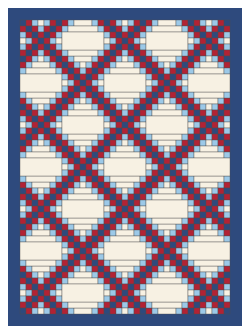
A throw: 52½ × 73½ inches
| Fabric | For block A (18) | For block B (17) | Total 2-inch strips |
|---|---|---|---|
| Navy | 13 strips | none | 13 |
| Red | 20 strips | 4 strips (68 squares) | 24 |
| Light blue | 12 strips | 7 strips (136 squares) | 19 |
| Cream | 4 strips | 6 strips 5 in wide (17 rectangles 11 × 5), 7 strips 2 in (34 rectangles 8 × 2), 5 strips 2 in (34 rectangles 5 × 2) | 16 strips 2 in plus 6 strips 5 in |
Block A needs 2 strip sets each of rows 1, 2 and 3 (36 segments each, from 40) and 1 strip set of row 4 (18 segments from 20). Counts use 40 usable inches of fabric width. Border, backing and binding are extra; StitchTested's yardage guide covers them.
Lay out 7 rows of 5, starting odd rows with A and even rows with B. Press the seams in each row toward the B blocks, which have fewer seams, and join the rows.
Common mistakes and fixes
- A chain stops at a block edge. A segment in block A is in the wrong place; rows 2 and 3 look alike at a glance. Lay out each A block and check the navy X before sewing.
- Squares don't line up across the seams between blocks. The strip sets were sewn with a scant or wide seam, so the A blocks don't match the B blocks. Measure the first A block and adjust the B center rectangle to match it.
- Strip sets wave. Seven strips sewn in one direction pull into an arc. Sew pairs first and alternate directions.
- The chains blur together. The three chain colors are too close in value. Put the three chain fabrics side by side and photograph them in black and white before you cut.
Related blocks
Start smaller with the single Irish chain, or follow the full double Irish chain pattern. For another strip-pieced quilt with diagonal movement, see the trip around the world. Other seven-patch blocks include the bear's paw. To work out a different square size, the quilt block resizer explains the grid math, and the quilt block library lists every block on the site.
You might also like
 Single Irish chain quilt blockNine-patches alternating with plain squares so the dark squares link into diagonal chains.
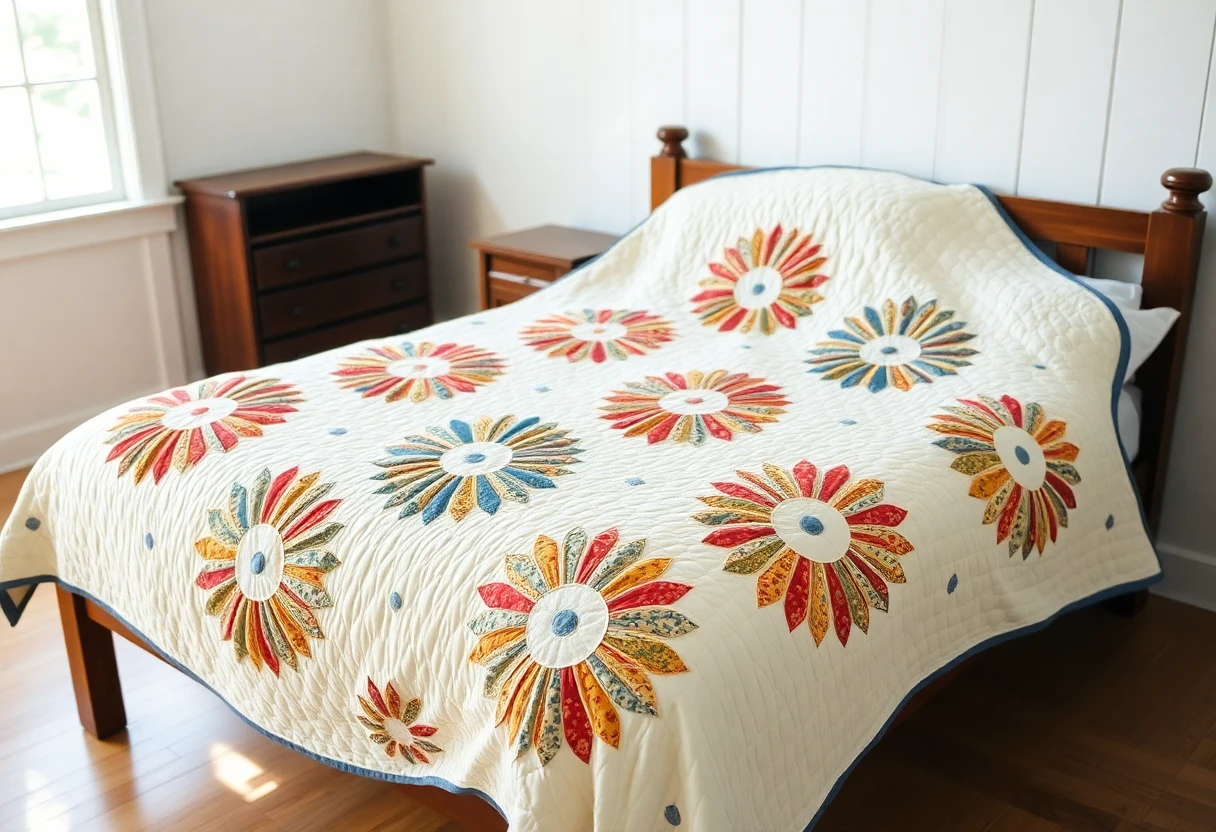 Dresden plate quilt blockWedge-shaped blades with pointed or rounded tips, sewn into a ring and appliqued onto a background square.
 Jacob's ladder quilt blockFive four-patches and four triangle squares that link into diagonal ladders, cut for 6, 9 and 12 inch blocks.
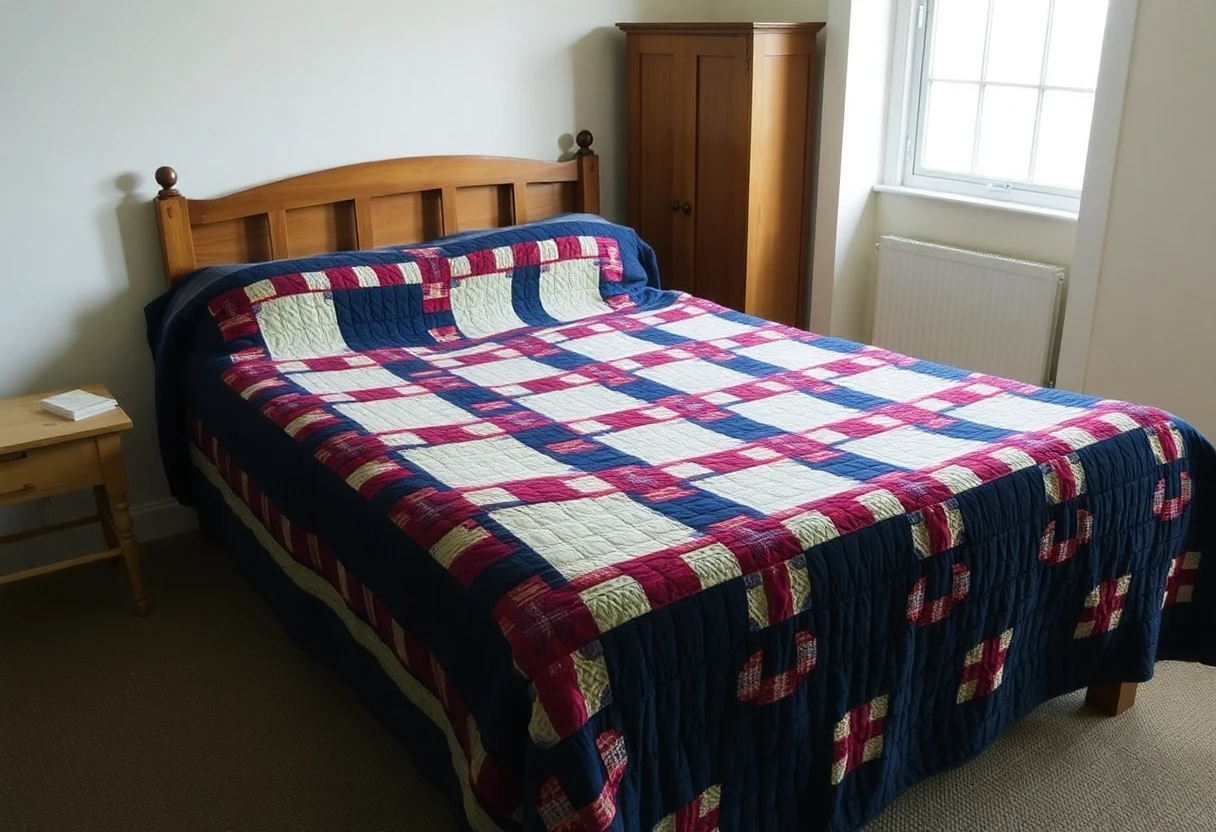 Double Irish chain quiltNavy and red chains on cream, 58 x 78 in, strip pieced so there are no tiny squares to cut one by one.