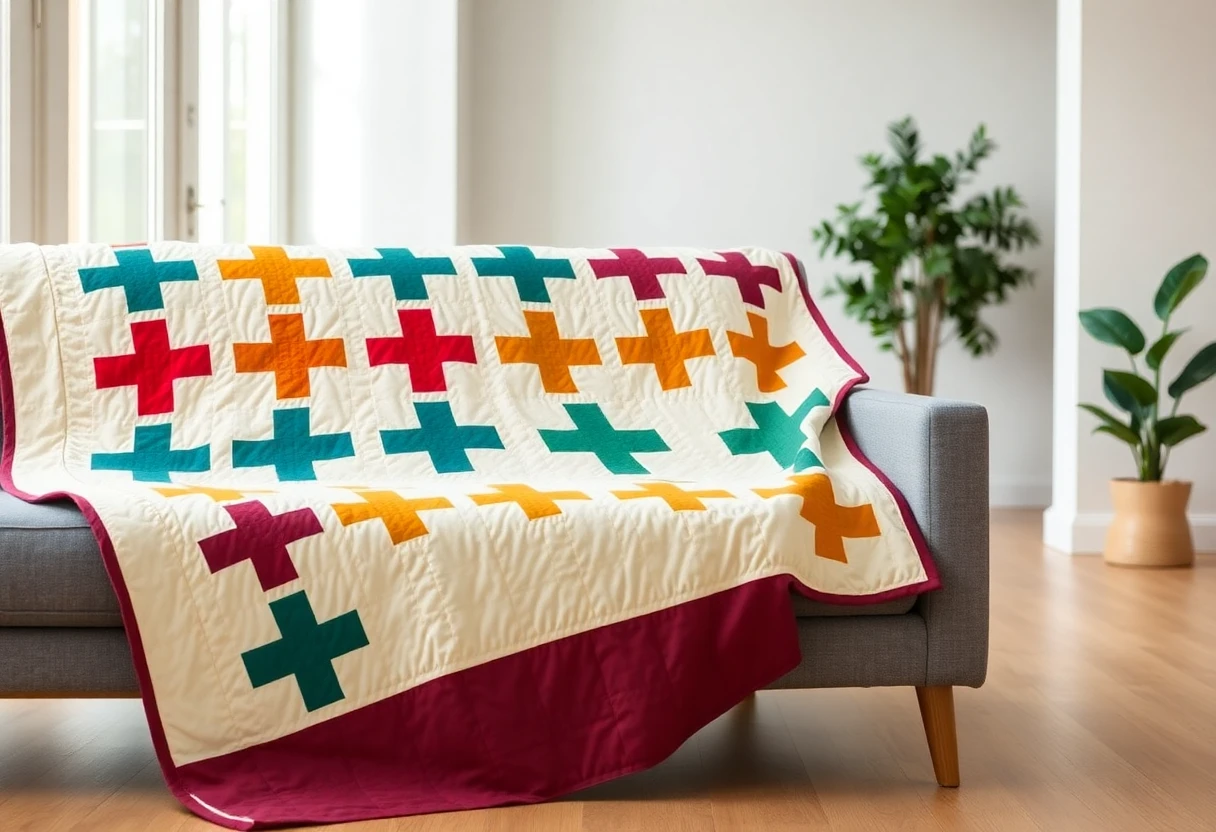
What makes it look modern
Modern quilts tend to share a few habits: solid or near-solid fabrics, simple shapes at a large scale, and more background than you'd expect. This pattern leans on all three. Two choices make the biggest difference:
- A background that is really plain. White, cream, a light gray or a pale linen-look solid all work. A small print turns the open space into texture and the pluses lose their punch.
- Plus colors with even contrast. If a few pluses are much darker or lighter than the rest, the eye jumps straight to them. Squint at your stack of fabrics; if one stands out, swap it.
For a single-color version, make every plus red on white and you have a quilt that echoes a Swiss flag reversed. Navy pluses on cream with one red plus placed off center is a quiet patriotic variation.
Fabric
| Fabric | Used for | Yardage |
|---|---|---|
| Plus colors | 30 pluses | 15 solids, ⅛ yd each, or 6 fat quarters |
| Background | Squares and frame strips | 3⅛ yd |
| Binding | Seven 2½-in strips | ⅝ yd |
| Backing | Two 80-in lengths, seamed | 4½ yd |
| Batting | At least 68 × 80 in | Twin size (72 × 90 in) |
Each plus needs one piece 3½ × 16½ inches. A 3½-inch strip across the width of the fabric holds two pluses, so 15 colors at one strip each make 30. A fat quarter (about 18 × 21 inches) gives five 3½-inch strips 21 inches long, one plus per strip. Our fat quarter guide covers the measurements.
Cutting
Plus fabrics (for each plus)
- 2 squares, 3½ × 3½ in
- 1 bar, 3½ × 9½ in
From each width-of-fabric strip, cut two bars and four squares (33 inches). Cut 30 sets in all.
Background
| Cut strips | Subcut | Number needed |
|---|---|---|
| 11 strips, 3½ in | Squares 3½ × 3½ in, 11 per strip | 120 |
| 15 strips, 2 in | Side frames 2 × 9½ in, 4 per strip | 60 |
| 20 strips, 2 in | Top and bottom frames 2 × 12½ in, 3 per strip | 60 |
Cut the binding fabric into 7 strips 2½ inches × the width of the fabric.
Sew a block
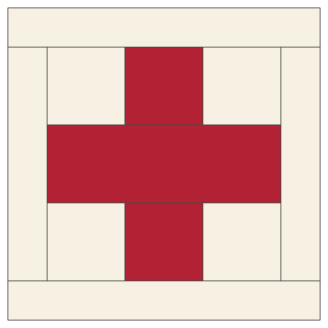
- Top row: sew a background square to each side of a plus square. Press toward the plus. The row measures 9½ × 3½ inches. Make a second identical row for the bottom.
- Sew the top row to one long edge of the plus bar and the bottom row to the other, lining up the plus square with the center of the bar. Fold the bar in half and finger-press a crease to find its center; match it to the middle of the plus square. Press toward the bar. The plus unit measures 9½ inches square.
- Sew a 2 × 9½-inch frame strip to the left and right sides. Press toward the frame.
- Sew a 2 × 12½-inch strip to the top and bottom. Press toward the frame. The block measures 12½ inches square.
- Make 30 blocks.
Accurate seams matter more than usual here, because the plus arms are only 3 inches wide and a skimpy seam shows as a crooked arm. If your plus units come out at 9¼ inches, see how to sew a quarter-inch seam before making all 30.
Lay out and sew the top
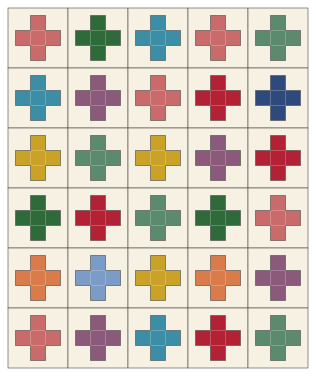
Lay out 6 rows of 5 blocks on the floor or a design wall. Move colors around until no two matching or near-matching pluses touch, and stand back: a single plus that is darker than the rest shows up immediately from across the room. Sew the blocks into rows, press the seams in alternate rows in opposite directions, and join the rows. The top measures 60½ × 72½ inches. There is no border; the background frames already finish the edge.
Finish
Seam the two 80-inch backing lengths along the long edges (about 79½ × 80 inches; the quilt needs 68 × 80). Baste, then quilt. Modern quilts often use straight lines with a walking foot: evenly spaced vertical lines every inch or so, or a grid that runs through the plus arms. Dense straight-line quilting gives the background a crisp, slightly crinkled texture after washing. Straight-line machine quilting has spacing and marking tips. Bind with the seven 2½-inch strips (perimeter 264 inches; seven joined strips give about 277). A solid binding in the background color makes the quilt look edge-to-edge; a binding in one of the plus colors frames it.
Other sizes
| Layout | Blocks | Plus strips (3½ in) | Background | Finished |
|---|---|---|---|---|
| 3 × 4 | 12 | 6 | 1⅜ yd | 36 × 48 in (baby) |
| 4 × 5 | 20 | 10 | 2¼ yd | 48 × 60 in (lap) |
| 5 × 6 (this pattern) | 30 | 15 | 3⅛ yd | 60 × 72 in (throw) |
| 6 × 8 | 48 | 24 | 5 yd | 72 × 96 in (twin) |
| 7 × 8 | 56 | 28 | 5⅞ yd | 84 × 96 in (full or queen) |
The 3 × 4 baby size is a fast gift in bright primaries. For backing and binding at other sizes, use StitchTested's binding and backing calculator. More quilt ideas in the same spirit are on our quilt ideas page, and the postage stamp quilt is the opposite approach: no background at all.
More free patterns: see them all. This pattern is free for personal and charity use; please don't sell the pattern itself.
You might also like
 One-layer-cake throwAll 42 squares of one layer cake plus a border, a 64 x 73 in throw in an afternoon of sewing.
 Disappearing nine-patch quiltA plain nine-patch cut in quarters and turned, which looks far harder than it is; 20 blocks from charm squares for a 62 x 75 in throw.
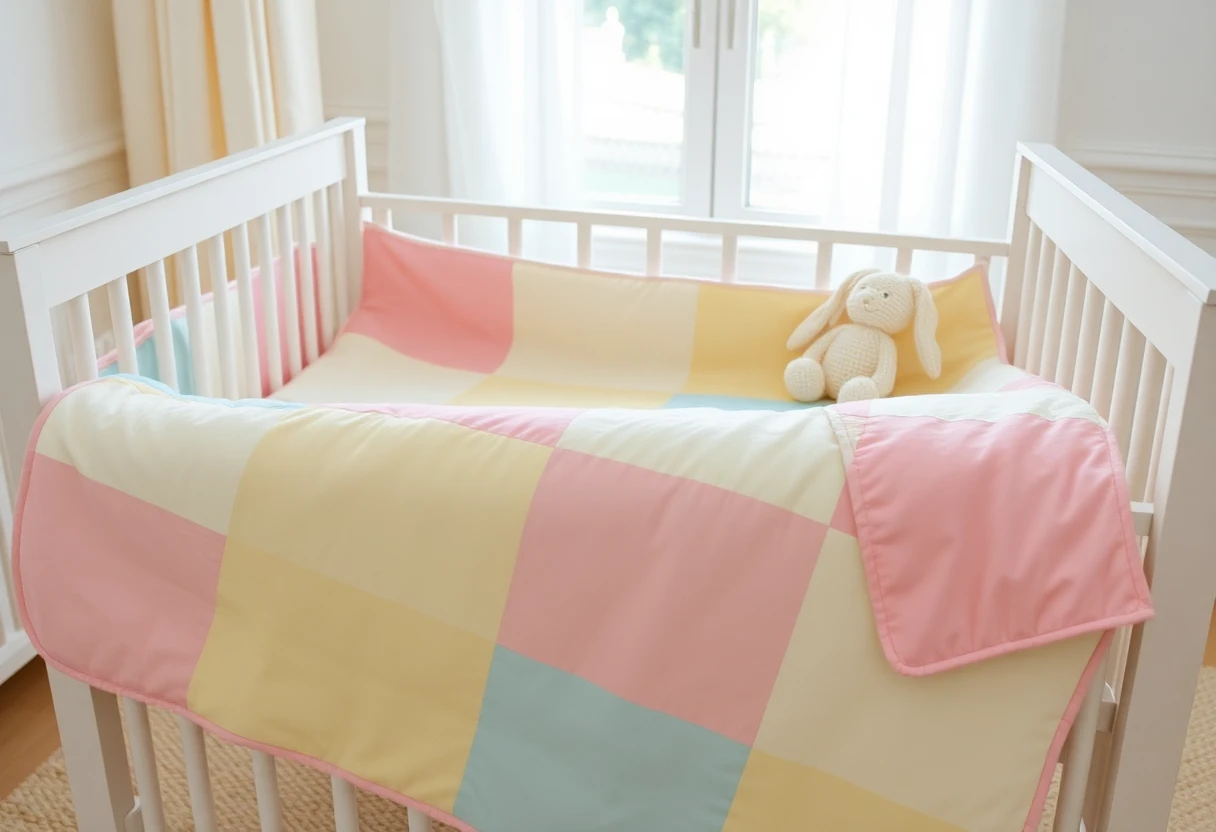 Easy baby quilt48 big squares from 8 fat quarters, 36 x 48 in, with crib, toddler and throw sizes.
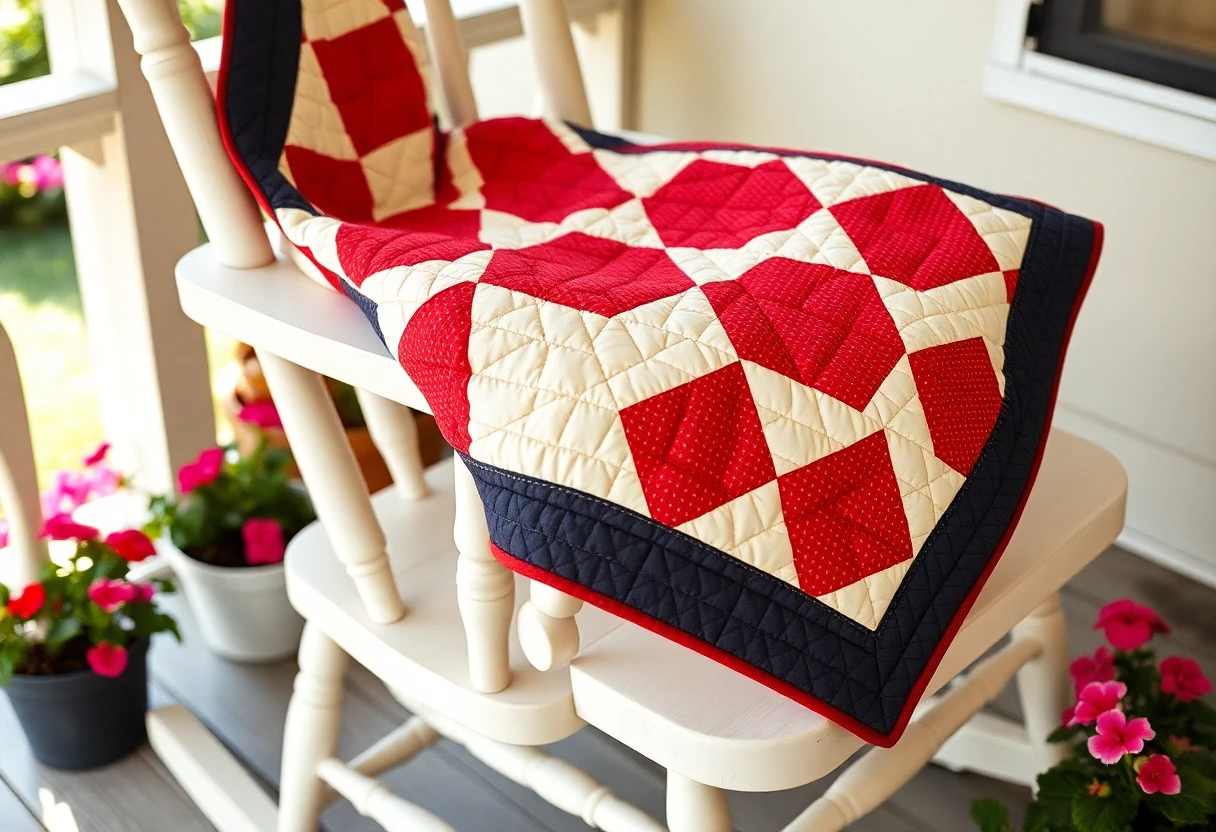 Nine-patch throw quiltThe classic first quilt, a 53 x 71 in throw with only squares to cut and sew.