
If that sounds like a plain nine-patch quilt, it is, with one rule: the nine-patches must have the dark fabric in the corners and center, and the plain blocks must be the same fabric as the light squares. Then the light disappears into the background and the dark squares read as chains. Our nine-patch throw is built the same way in red and cream, with a full fabric list.
Cutting chart (one pair of blocks)
| Finished block | Nine-patch: dark | Nine-patch: background | Plain block: background | Strip width (both fabrics) |
|---|---|---|---|---|
| 6 in | 5 squares 2½ in | 4 squares 2½ in | 1 square 6½ in | 2½ in |
| 9 in | 5 squares 3½ in | 4 squares 3½ in | 1 square 9½ in | 3½ in |
| 12 in | 5 squares 4½ in | 4 squares 4½ in | 1 square 12½ in | 4½ in |
Each small square finishes at a third of the block and is cut ½ inch bigger. The plain block is cut at the finished block size + ½ inch, so both blocks measure the same unfinished (6½, 9½ or 12½ inches). All sizes were checked by calculation.
Strip piecing the nine-patches
A nine-patch has two kinds of rows: dark, light, dark (top and bottom) and light, dark, light (middle). Sew strips into those two strip sets, cut them into segments the width of one strip, and you never handle single small squares.
- Cut strips across the width of the fabric at the strip width in the chart.
- Strip set A: sew a dark strip to each side of a light strip. Strip set B: sew a light strip to each side of a dark strip. Sew each seam in the opposite direction from the one before (top to bottom, then bottom to top) to keep the set from curving.
- Press set A toward the dark and set B toward the dark too. Because the dark is in the middle of B and on the outside of A, the seams face opposite ways and nest.
- Square up one end and cut segments the strip width (3½ inches for a 9-inch block). A 40-inch strip set gives 11 segments of 3½ inches.
- Sew A, B, A segments together for each nine-patch. Press the two long seams toward the A rows or open.
- Measure: each nine-patch should match the plain block.
A quilt-sized example: 63 × 81 inches
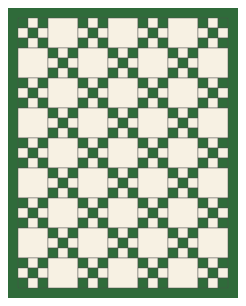
Use an odd number of blocks in both directions so all four corners of the quilt are nine-patches and the chains run off every edge. With 7 × 9 blocks at 9 inches:
| What | How many | Cut |
|---|---|---|
| Nine-patches | 32 | 64 A segments, 32 B segments |
| Strip set A (dark, light, dark) | 6 sets | 66 segments, 2 spare |
| Strip set B (light, dark, light) | 3 sets | 33 segments, 1 spare |
| Dark strips, 3½ in | 15 | 12 for set A, 3 for set B |
| Background strips, 3½ in | 12 | 6 for set A, 6 for set B |
| Plain blocks, 9½ in | 31 | from 8 strips 9½ in wide (4 per strip) |
The counts assume 40 usable inches across the fabric. That's a top before borders; for the yardage of borders, backing and binding, use StitchTested's fabric yardage guide and binding and backing calculator.
Assembly
- Lay out the rows, starting each odd row with a nine-patch and each even row with a plain block.
- Sew the blocks into rows. Press toward the plain blocks; the plain block has no seams to fight, so it takes the pressing easily, and the rows will nest when joined.
- Join the rows, matching the corner of each nine-patch to the corner of the nine-patches diagonally above and below. That's where the chain links; a gap of even ⅛ inch shows.
Variations
Change the center square of each nine-patch to a second color and the chains get a dot at every crossing. Use a different dark in every block and you have a scrappy chain that uses up 3½-inch strips. The plain blocks are big open spaces: quilt a feather wreath or a star there, or let people sign them for a signature quilt.
Turn the whole layout on point and the chains run straight up and down and across; you'll need side and corner setting triangles, which our setting triangle calculator sizes for you.
Common mistakes and fixes
- Chains look broken. Some nine-patches have the dark on the sides instead of the corners (a B, A, B stack). Every nine-patch is A, B, A.
- Plain blocks don't match the nine-patches. The seam allowance was wider than ¼ inch on the nine-patches, which then come out small. Measure one nine-patch before cutting all the plain blocks, and cut the plain blocks to match it.
- Strip sets curve like a banana. All seams were sewn in the same direction. Alternate directions, and press from the right side.
- Even-numbered rows: the quilt ends with a plain block in a corner. Use odd numbers of rows and columns.
Related blocks
The next steps up are the double Irish chain (a 5 × 5 chain block) and the triple Irish chain (7 × 7). For a nine-patch with triangles, try the Jacob's ladder or the shoofly. To resize the nine-patch, use the quilt block resizer, and see every block in the quilt block library.
You might also like
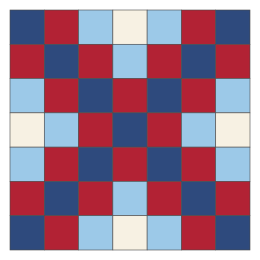 Triple Irish chain quilt blockA 7 x 7 chain block and a background block that link into three-square-wide chains.
 Jacob's ladder quilt blockFive four-patches and four triangle squares that link into diagonal ladders, cut for 6, 9 and 12 inch blocks.
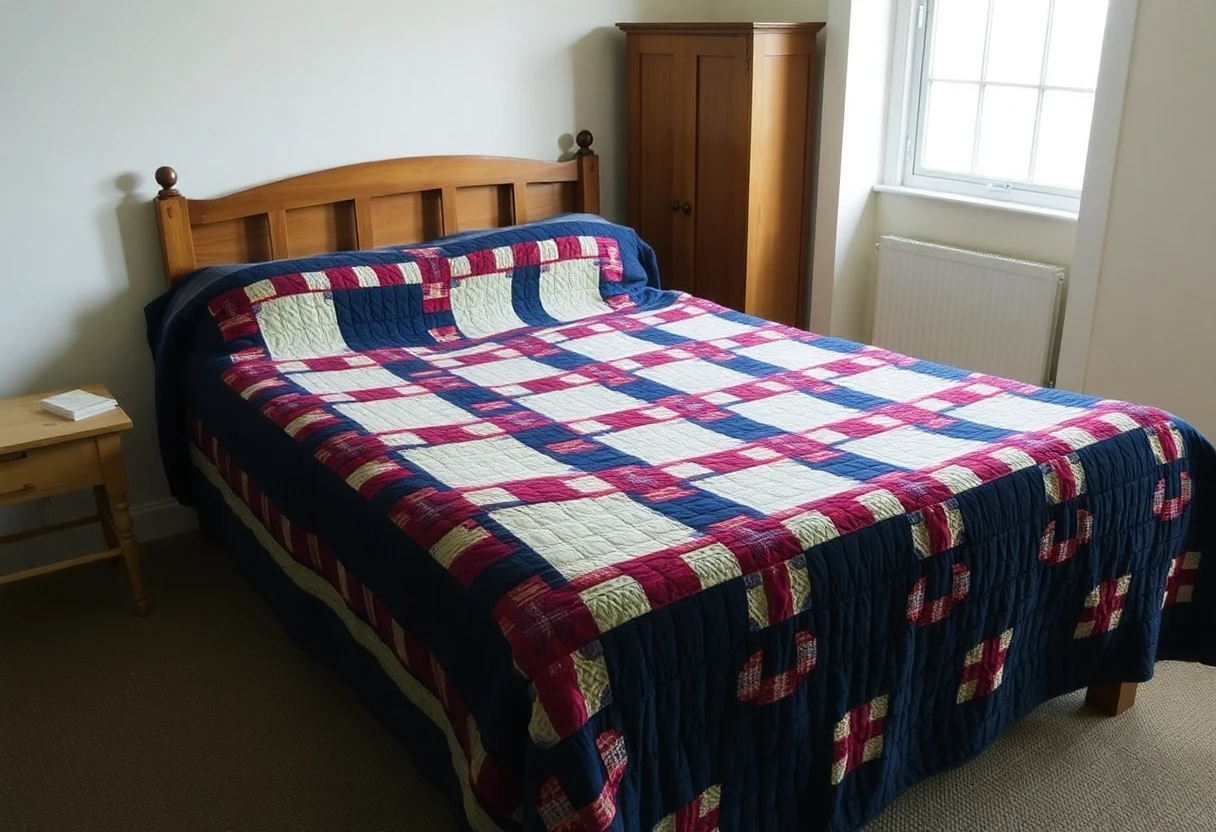 Double Irish chain quiltNavy and red chains on cream, 58 x 78 in, strip pieced so there are no tiny squares to cut one by one.
 Postage stamp scrap quilt1,080 tiny squares from the scrap bin in a light and dark checkerboard, sewn in strip sets so you rarely handle a single square; 60 x 72 in.