
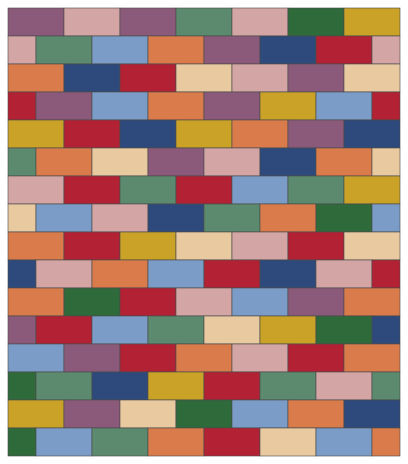
Fabric
| Fabric | Amount |
|---|---|
| Fat quarters (18 × 21 in) | 14 |
| Binding | ½ yd |
| Backing | 4 yd |
| Batting | Twin size (72 × 90 in) |
Fat quarters vary slightly in size. If several of yours measure under 18 inches in one direction after you straighten the edges, buy a 15th for the half bricks.
Picking the fat quarters
A brick quilt has no block outlines, so the only structure is the contrast between neighboring bricks. Fourteen fat quarters that are all mediums turn into a pleasant blur. Aim for roughly four lights, six mediums and four darks, and use the 14th fat quarter (the half bricks) in a medium, since those squares sit at the edges where a dark would frame the quilt in an uneven stripe. Lay the stack out fanned on the floor and take a photo in black and white; if two fabrics read as the same gray, keep them apart in the layout.
Large-scale prints get chopped. A brick shows a 4 × 8-inch window, so a 6-inch flower ends up as a petal and a stem. Prints with motifs under 2 inches, tone-on-tones, small checks and solids all hold up.
Watch for one-way prints. In the cut below, each brick's long side runs with the 18-inch side of the fat quarter, which is the side that had the selvage. Check your print: if its motifs stand up along that edge, they'll lie on their sides once the brick is sewn in horizontally. To keep them upright, cut that fat quarter the other way: four 4½-inch strips running parallel to the 21-inch side, each about 21 inches long, with two bricks from each strip. That still gives 8 bricks, but four strips use all 18 inches, so it only works if the fat quarter measures a full 18 after squaring. A short one gives three strips and 6 bricks.
Cutting
A brick is cut 4½ × 8½ inches (4 × 8 finished). A half brick is a 4½-inch square.
- From each of 13 fat quarters: with the 21-inch side running top to bottom, cut four strips 4½ inches wide, so each strip is about 18 inches long. Cut two bricks from each strip, 8 bricks per fat quarter, 104 in all.
- From the 14th fat quarter: cut four 4½-inch strips the same way and cut each into four 4½-inch squares, 16 half bricks in all.
- Binding: cut seven 2½-inch strips.
The strips have about an inch to spare in length and 3 inches in width, which is the slack that lets a slightly short fat quarter still give 8 bricks.
Lay out and sew
- Rows 1, 3, 5 and so on (8 rows): 7 bricks each.
- Rows 2, 4, 6 and so on (8 rows): a half brick, 6 bricks, then a half brick.
- Spread the prints out so no two bricks of the same fabric touch, including the bricks above and below. Photograph the layout before you start sewing.
- Sew each row with a ¼-inch seam. Every row should measure 56½ inches; if one is short, check for a narrow brick or a wide seam.
- Join the rows. Because the seams don't line up, you only need to pin at the ends and the middle. The top measures 56½ × 64½ inches.
Pressing
Since no seam meets another one across a row, pressing direction is about bulk and show-through, not nesting. Press the short seams in each row toward the darker brick of each pair; where two mediums meet, either way is fine. Press every long row seam toward the bottom of the quilt. That puts all the long allowances on one side, so the top lies flat and the walking foot rides over them evenly when you quilt along the rows.
When rows come out different lengths
The offset rows have 8 pieces and 7 seams; the full rows have 7 pieces and 6 seams. A seam that's a hair too wide costs twice its error in row length, so an offset row loses a little more than a full row, and with a 5/16-inch seam the two kinds of row end up about ⅛ inch apart. That much eases in with a pin at each end and the middle. If a row is ½ inch or more off the others, it's almost always one brick: measure each brick in that row, or look for a seam that drifted at the start. Unpicking one seam and resewing it is quicker than trying to ease half an inch along 56 inches, which shows as a ripple.
Finish
Seam two 72-inch backing lengths side by side. Bind with the seven strips.
Horizontal lines along every row are the obvious choice: stitch in the ditch of each row seam, or ¼ inch above and below it, with a walking foot. A vertical grid also works here in a way it doesn't on most quilts. The brick seams in the full rows sit 8 inches apart, and in the offset rows they're shifted 4 inches, so vertical lines every 4 inches run along every brick seam in alternating rows and through the middle of the bricks between. Add the horizontal row lines and the quilting makes a 4-inch grid that lines up with the bricks. Straight-line machine quilting covers marking and spacing. An all-over wave suits the bricks too, if you'd rather not mark anything.
Other sizes
Every size uses the same cuts: four 4½-inch strips per fat quarter, two bricks or four half bricks per strip. Cut bricks until you have enough, then turn the leftover strips into half bricks; a half brick can't come from the 1-inch scrap at the end of a brick strip. A strip can also give one brick and two half bricks (17½ inches).
| Finished | Bricks per row × rows | Bricks | Half bricks | Fat quarters | Binding | Backing | Batting |
|---|---|---|---|---|---|---|---|
| 40 × 48 in (baby) | 5 × 12 | 54 | 12 | 8 | 5 strips, ⅜ yd | Two 48-in lengths, 2¾ yd | Throw size (60 × 60 in) |
| 56 × 64 in (this pattern) | 7 × 16 | 104 | 16 | 14 | 7 strips, ½ yd | Two 72-in lengths, 4 yd | Twin size (72 × 90 in) |
| 64 × 88 in (twin) | 8 × 22 | 165 | 22 | 23 | 9 strips, ¾ yd | Two 96-in lengths, 5⅜ yd | Full size (81 × 96 in), just long enough |
| 72 × 80 in (large throw) | 9 × 20 | 170 | 20 | 23 | 9 strips, ¾ yd | Three 80-in lengths, 6¾ yd | Full size (81 × 96 in) |
| 88 × 96 in (queen) | 11 × 24 | 252 | 24 | 33 | 11 strips, ⅞ yd | Three 96-in lengths, 8 yd | King (120 × 120 in) |
In each size, half the rows are full rows of bricks and the other half start and end with a half brick and hold one brick fewer. The fat quarter counts leave three spare strips at most, so buy one extra if you want room to skip a fabric that doesn't play well with the rest. Except at this pattern's size and the twin, the backing lengths are turned so the seams run across the quilt. All the sizes were checked by calculation. Check the backing against your own longarm quilter's margin with StitchTested's binding and backing calculator, and see their quilt size chart if you're matching a particular mattress.
Variations
- Two-color: alternate light and dark fat quarters for a striped wall effect.
- Red, white and blue fat quarters at the 72 × 80 size make a quilt that fits the Quilts of Valor size range.
- Turn the whole top a quarter turn and the bricks stack vertically like a bookshelf. The cutting doesn't change, but a one-way print then wants the standard cut, not the turned one.
More fat quarter ideas: our baby quilt uses 8 of them, and what is a fat quarter covers sizes and cutting. See all free quilt patterns. This pattern is free for personal and charity use; please don't sell the pattern itself.
You might also like
 What is a fat quarter?The 18 x 22 inch cut explained, a cutting chart, and how many fat quarters common quilts take.
 Easy baby quilt48 big squares from 8 fat quarters, 36 x 48 in, with crib, toddler and throw sizes.
 Flannel rag quiltNo binding and no separate quilting; seams on the front fray into a soft, cozy finish in the wash.
 Double Irish chain quiltNavy and red chains on cream, 58 x 78 in, strip pieced so there are no tiny squares to cut one by one.